Ecosystem Management Technician
Be a part of the solution. Within this program you will contribute to the health of ecosystems, minimizing the negative impact we have on the environment.
Program Information
Start Date
January 11, 2027
Domestic Availability
Accepting Applications
International Availability
Accepting Applications
CIP Code
03.0201
Program Code
EMT
Delivery
In Person
Credential
Ontario College Diploma
Academic School
Location
Program Contact
Domestic Tuition
per semester*
International Tuition
per semester*
View Curriculum
September 07, 2027
Domestic Availability
Accepting Applications
International Availability
Coming Soon
CIP Code
03.0201
Program Code
EMT
Delivery
In Person
Credential
Ontario College Diploma
Academic School
Location
Program Contact
Domestic Tuition
per semester*
International Tuition
per semester*
*Domestic tuition amounts shown are from the 2026-2027 academic year and are subject to change.
*International tuition amounts shown are from the 2026-2027 academic year and are subject to change.
Apply Now
Canadian StudentsView Curriculum
January 10, 2028
Domestic Availability
Accepting Applications
International Availability
Coming Soon
CIP Code
03.0201
Program Code
EMT
Delivery
In Person
Credential
Ontario College Diploma
Academic School
Location
Program Contact
Domestic Tuition
per semester*
International Tuition
per semester*
*Domestic tuition amounts shown are from the 2026-2027 academic year and are subject to change.
*International tuition amounts shown are from the 2026-2027 academic year and are subject to change.
Apply Now
Canadian StudentsView Curriculum
This program highlights a holistic approach to the management of human activity within ecosystems. We will prepare you for an exciting career that can take you where you want to go, either in your home community, in a wilderness environment, or across the globe. Through careful consideration of the needs of society and the environment, you'll help governments, conservation groups, and wildlife organizations undertake environmentally sustainable planning for the future.
Within the program, you'll study ecosystem composition, structure and function in wilderness, rural, and urban landscapes, and acquire a broad range of technical skills, as well as the flexibility to adapt to changing job requirements. As well, you will:
- learn the principles of experimental design and research, and how to apply them to a project of your own
- participate in the monitoring and assessment of aquatic and terrestrial habitats, conduct resource inventories and environmental sampling, and develop plans for the management of public and private landscapes
- conduct field research in partnership with a variety of organizations and analyze data generated by this work
- learn to use Geographic Information Systems (GIS) technology to analyze ecosystems at a variety of scales.
* Students starting in January are required to attend classes over the summer semester.
- Ecosystem Management is on the leading edge of resource conservation in the 21st century.
- The School of Environmental and Natural Resource Sciences at the Frost Campus encourages small class sizes and provides state-of-the-art technology.
- Dedicated, award-winning faculty provide a challenging and dynamic learning environment in the heart of the Kawartha Lakes region.
- While you learn about ecosystem science and the current techniques of sustainable resources management, you will also develop essential skills in communications, human relations, facilitation, problem solving, dispute resolution, and cultural awareness.
- This combination of skills and knowledge is transferrable on a global scale.
Many of our programs offer the opportunity to earn a second certificate or diploma with just one or two additional semesters of study. Add another specialization to your skill set and increase your career prospects with this unique opportunity.
Learn more here or contact your program coordinator for more information.
The program provides the student with a two-week (80 hour) mandatory field placement. This placement is designed to allow you to apply your skills, demonstrate your abilities and obtain valuable work experience that many employers are looking for.
Certain diploma programs within the School of Environmental and Natural Resource Sciences (SENRS) share some first-semester courses providing students a flexible and interdisciplinary academic start. This allows students to:
- Explore various fields of study within environmental and natural resource sciences
- Discover careers that align with their strengths and interests
- Transfer credits between programs, reducing duplication and saving time
By earning credits that apply across multiple diplomas, students will have the chance to work toward more than one credential without starting from scratch. This also opens doors to a multidisciplinary education, in which students gain a strong foundation in key concepts and practical skills that can be applied across industries.
To help you succeed in this program and career you need:
- the ability to ask questions, solve problems and create sustainable plans
- an interest in understanding how ecosystems and humanity interact
- analytical and creative thinking
- excellent oral and written communication skills
- the ability to work as part of a team
- good organizational ability
- cultural awareness/sensitivity
- excellent interpersonal skills
- volunteer or work experience in such areas as conservation, parks, greenspace projects, public education about the environment, or habitat restoration is an asset.
As a Technician, you'll find work in careers such as:
- resource management technician
- urban forest management
- geomatics technician
- aquatic/terrestrial biologist
- environmental education
- land use planning
- restoration technician
- watershed technician
- environmental consultant, and others.
You'll work for conservation authorities, parks departments, private consulting firms, municipal/provincial/federal governments, non-governmental organizations, First Nations communities, or stewardship organizations. Positions can be found across Canada and around the world. Willingness to relocate for work, and taking the initiative to develop contacts in the field greatly enhances the opportunities available to you.
As a student in this program you will be required to:
- Participate in field activities, sometimes in remote areas, including walking several kilometers over rough terrain, carrying heavy gear, and working in all weather conditions such as rain, deep snow and extreme temperatures.
- Participate in activities that require reading, interpreting and creating maps using Geographic Positioning Systems and Geographic Information System software, topographic paper maps and aerial photographs.
- Identify landscape features, rocks, minerals, soil layers, flora and fauna, including microscopic plankton and invertebrates for the purposes of habitat assessment. Identification of these elements of the ecosystem will be based almost exclusively on live and/or preserved specimens, objects or samples, maps and photographs etc.
- Apply verbal and non-verbal communication techniques in a team context to resolve conflicts and achieve project goals.
Plan to spend about $925 in the first year and $525 in the second year for the cost of books, supplies and field camps.
The Indigenous Perspectives Designation (IPD) is an option available to students in this program. To qualify for an IPD, you must take and successfully complete a series of required Indigenous Studies courses as well as participate in a minimum of four approved co-curricular Indigenous events or experiences. Your transcript will indicate the IPD upon graduation, a designation that provides you with a comprehensive understanding of Indigenous cultures, histories, traditions, and contributions to our shared society within the context of your program of study. The IPD provides a valuable skill set sought after in today's employment sector. For more information, please click on the following link: Indigenous Perspectives Designation : Fleming College
- Participate in resource management planning based on knowledge of relevant government structures, policies, terminology and legislation.
- Effectively communicate the foundational principles of Ecosystem Management in a variety of formats, including oral, written, computer-based and other technologies, to a variety of audiences.
- Work effectively with a wide variety of sampling tools and technologies to accurately collect, organize, analyze, interpret and communicate ecological and spatially geo-referenced data.
- Respect a variety of worldviews and perspectives on ecology, sustainability, and the role that humans play within ecosystems at the local, regional, and global level.
- Apply the scientific method and the principles of scientific inquiry to complete collaborative research studies on ecosystem dynamics and ecosystem function at a variety of spatial and temporal scales.
- Develop oral and written communication skills in the completion of proposals and grant applications to secure resources for the implementation of ecosystem management projects.
- Apply current and emerging protocols to study ecosystem biodiversity, composition, structure and function.
- Develop conflict resolution, facilitation and negotiating skills to work effectively with others in a collaborative, solutions-based environment to prevent and/or mitigate the impacts of human activity within ecosystems.
- Prepare internal reports and field records, documenting information accurately and in a timely manner, in compliance with industry and government regulations, established policies and procedures.
- Operate and maintain tools and equipment appropriately, in compliance with industry safety and operating standards, ensuring optimum health and safety of self, team members and the environment.
Students applying to Ecosystem Management Technician must meet the following requirements:
- OSSD including Gr 12 C English and Gr 12 C Math
Windows (ideal) or Mac computer. Information about hardware requirements can be found on the ArcGIS Desktop system requirements page.
Transfer Agreements
You may be able to use credits obtained at Fleming College to continue your postsecondary education in pursuit of a degree. The articulation and credit transfer agreements with our partner institutions are summarized here.
Bachelor of Science (General) in Biology
Requirement
- Minimum 3.0 cumulative program Grade Point Average (GPA).
Transfer Credit
- 39 out of a 90-credit degree.
- Refer to ONTransfer.ca for further details.
To apply please see the Ontario Universities' Application Centre (OUAC) website.
For more information
Visit the Algoma University website for further articulation and program information.
Visit the ONTransfer.ca website for agreement information.
Bachelor of Science in Biology
Requirement
- Minimum 3.0 cumulative program Grade Point Average (GPA).
Transfer Credit
- 45 out of a 120-credit degree.
- Refer to ONTransfer.ca for further details.
To apply please see the Ontario Universities' Application Centre (OUAC) website.
For more information
Visit the Algoma University website for further articulation and program information.
Visit the ONTransfer.ca website for agreement information.
Bachelor of Commerce
Requirement
- Completion of the program.
Transfer Credit
- 30 out of a 120-credit degree.
- Refer to the articulation statement for further details.
To apply please see the Apply Alberta website.
For more information
Visit the Athabasca University website for further articulation and program information.
See the official articulation agreement.
Bachelor of Commerce in Accounting
Requirement
- Completion of the program.
Transfer Credit
- 30 out of a 120-credit degree.
- Refer to the articulation statement for further details.
To apply please see the Apply Alberta website.
For more information
Visit the Athabasca University website for further articulation and program information.
See the official articulation agreement.
Bachelor of Commerce in Business Technology Management
Requirement
- Completion of the program.
Transfer Credit
- 30 out of a 120-credit degree.
- Refer to the articulation statement for further details.
To apply please see the Apply Alberta website.
For more information
Visit the Athabasca University website for further articulation and program information.
See the official articulation agreement.
Bachelor of Commerce in Finance
Requirement
- Completion of the program.
Transfer Credit
- 30 out of a 120-credit degree.
- Refer to the articulation statement for further details.
To apply please see the Apply Alberta website.
For more information
Visit the Athabasca University website for further articulation and program information.
See the official articulation agreement.
Bachelor of Commerce in Human Resources Management
Requirement
- Completion of the program.
Transfer Credit
- 30 out of a 120-credit degree.
- Refer to the articulation statement for further details.
To apply please see the Apply Alberta website.
For more information
Visit the Athabasca University website for further articulation and program information.
See the official articulation agreement.
Bachelor of Commerce in Indigenous Business
Requirement
- Completion of the program.
Transfer Credit
- 30 out of a 120-credit degree.
- Refer to the articulation statement for further details.
To apply please see the Apply Alberta website.
For more information
Visit the Athabasca University website for further articulation and program information.
See the official articulation agreement.
Bachelor of Commerce in Marketing
Requirement
- Completion of the program.
Transfer Credit
- 30 out of a 120-credit degree.
- Refer to the articulation statement for further details.
To apply please see the Apply Alberta website.
For more information
Visit the Athabasca University website for further articulation and program information.
See the official articulation agreement.
Bachelor of Human Resources and Labour Relations (General)
Requirement
- Completion of the program.
Transfer Credit
- 30 out of a 90-credit degree.
- Refer to the articulation statement for further details.
To apply please see the Apply Alberta website.
For more information
Visit the Athabasca University website for further articulation and program information.
See the official articulation agreement.
Bachelor of Management (General)
Requirement
- Completion of the program.
Transfer Credit
- 30 out of a 90-credit degree.
- Refer to the articulation statement for further details.
To apply please see the Apply Alberta website.
For more information
Visit the Athabasca University website for further articulation and program information.
See the official articulation agreement.
Bachelor of Professional Arts in Communication Studies
Requirement
- Completion of the program.
Transfer Credit
- 60 out of a 120-credit degree.
- Refer to the articulation statement for further details.
To apply please see the Apply Alberta website.
For more information
Visit the Athabasca University website for further articulation and program information.
See the official articulation agreement.
Bachelor of Professional Arts in Criminal Justice
Requirement
- Completion of the program.
Transfer Credit
- 60 out of a 120-credit degree.
- Refer to the articulation statement for further details.
To apply please see the Apply Alberta website.
For more information
Visit the Athabasca University website for further articulation and program information.
See the official articulation agreement.
Bachelor of Professional Arts in Governance, Law and Management
Requirement
- Completion of the program.
Transfer Credit
- 60 out of a 120-credit degree.
- Refer to the articulation statement for further details.
To apply please see the Apply Alberta website.
For more information
Visit the Athabasca University website for further articulation and program information.
See the official articulation agreement.
Bachelor of Professional Arts in Human Services
Requirement
- Completion of the program.
Transfer Credit
- 60 out of a 120-credit degree.
- Refer to the articulation statement for further details.
To apply please see the Apply Alberta website.
For more information
Visit the Athabasca University website for further articulation and program information.
See the official articulation agreement.
Bachelor of Science
Requirement
- Completion of the program.
Transfer Credit
- 30 out of a 120-credit degree.
- Students admitted after Sept 1, 2026: 30-credit block. Students may receive up to 30 additional credits on a course-by-course basis, provided the diploma courses meet the requirements of AU's BSc (PD) programs.
- Refer to the articulation statement for further details.
To apply please see the Apply Alberta website.
For more information
Visit the Athabasca University website for further articulation and program information.
See the official articulation agreement.
Bachelor of Science in Applied Mathematics
Requirement
- Completion of the program.
Transfer Credit
- 30 out of a 120-credit degree.
- Refer to the articulation statement for further details.
To apply please see the Apply Alberta website.
For more information
Visit the Athabasca University website for further articulation and program information.
See the official articulation agreement.
Bachelor of Science in Biological Sciences
Requirement
- Completion of the program.
Transfer Credit
- 30 out of a 120-credit degree.
- Refer to the articulation statement for further details.
To apply please see the Apply Alberta website.
For more information
Visit the Athabasca University website for further articulation and program information.
See the official articulation agreement.
Bachelor of Science in Computing and Information Systems
Requirement
- Completion of the program.
Transfer Credit
- 30 out of a 120-credit degree.
- Refer to the articulation statement for further details.
To apply please see the Apply Alberta website.
For more information
Visit the Athabasca University website for further articulation and program information.
See the official articulation agreement.
Bachelor of Science (Ordinary) in Environmental Science with Ecology
Requirement
- Minimum 60% cumulative program average.
Transfer Credit
- Entry into 3rd-year studies of a 3-year program.
- Refer to the articulation agreement for further details.
To apply please see the KOM Consultants website.
For more information
Visit the Atlantic Technological University – Sligo website for further articulation and program information.
See the official articulation agreement.
Bachelor of Environmental Management
Requirement
- Minimum 70% cumulative program average.
- Required to complete the Lakehead University summer transition program.
Transfer Credit
- 10 out of a 20-credit degree.
- Refer to ONTransfer.ca for further details.
To apply please see the Ontario Universities' Application Centre (OUAC) website.
For more information
Visit the Lakehead University website for further articulation and program information.
Visit the ONTransfer.ca website for agreement information.
See the official articulation agreement.
Bachelor of Science in Forestry
Requirement
- Minimum 70% cumulative program average.
- Required to complete the Lakehead University summer transition program.
Transfer Credit
- 10 out of a 20-credit degree.
- Refer to ONTransfer.ca for further details.
To apply please see the Ontario Universities' Application Centre (OUAC) website.
For more information
Visit the Lakehead University website for further articulation and program information.
Visit the ONTransfer.ca website for agreement information.
See the official articulation agreement.
Bachelor of Arts - General
Requirement
- Minimum mid-70% cumulative program average.
Transfer Credit
- 60 out of a 120-credit degree.
- Refer to OntarioTech's website for further details.
To apply please see the Ontario Universities' Application Centre (OUAC) website.
For more information
Visit the Ontario Tech University website for further articulation and program information.
Bachelor of Arts in Educational Psychology
Requirement
- Minimum mid-70% cumulative program average.
Transfer Credit
- 60 out of a 120-credit degree.
- Refer to OntarioTech's website for further details.
To apply please see the Ontario Universities' Application Centre (OUAC) website.
For more information
Visit the Ontario Tech University website for further articulation and program information.
Bachelor of Arts in Educational Studies and Digital Technology
Requirement
- Minimum mid-70% cumulative program average.
Transfer Credit
- 60 out of a 120-credit degree.
- Refer to ONTransfer.ca for further details.
To apply please see the Ontario Universities' Application Centre (OUAC) website.
For more information
Visit the Ontario Tech University website for further articulation and program information.
Bachelor of Arts in Psychology
Requirement
- Minimum mid-70% cumulative program average.
Transfer Credit
- 60 out of a 120-credit degree.
- Refer to Ontario Tech's website for further details.
To apply please see the Ontario Universities' Application Centre (OUAC) website.
For more information
Visit the Ontario Tech University website for further articulation and program information.
Bachelor of Arts in Sociology, Technology and Innovation
Requirement
- Minimum mid-70% cumulative program average.
Transfer Credit
- 60 out of a 120-credit degree.
- Refer to OntarioTech's website for further details.
To apply please see the Ontario Universities' Application Centre (OUAC) website.
For more information
Visit the Ontario Tech University website for further articulation and program information.
Bachelor of Commerce
Requirement
- Minimum mid-70% cumulative program average.
- Completion of the Ontario Tech Commerce Bridge.
Transfer Credit
- 45 out of a 120-credit degree.
- Refer to ONTransfer.ca for further details.
To apply please see the Ontario Universities' Application Centre (OUAC) website.
For more information
Visit the Ontario Tech University website for further articulation and program information.
Bachelor of Arts in Environmental Practice
Requirement
- Minimum B cumulative program average.
Transfer Credit
- Entry into 3rd-year studies of a 4-year program.
- Refer to the articulation agreement for further details.
To apply please see the Royal Roads University's admissions website.
For more information
Visit the Royal Roads University website for further articulation and program information.
See the official articulation agreement.
Bachelor of Science in Environmental Practice
Requirement
- Minimum B cumulative program average.
Transfer Credit
- Entry into 3rd-year studies of a 4-year program.
- Refer to the articulation agreement for further details.
To apply please see the Royal Roads University's admissions website.
For more information
Visit the Royal Roads University website for further articulation and program information.
See the official articulation agreement.
Bachelor of Science in Environmental Science
Requirement
- Minimum B cumulative program average.
- Possess a recognized college or university level Chemistry course with a minimum 'B' (3.00/4.33) grade
Transfer Credit
- Entry into 3rd-year studies of a 4-year program.
- Refer to the articulation agreement for further details.
To apply please see the Royal Roads University's admissions website.
For more information
Visit the Royal Roads University website for further articulation and program information.
See the official articulation agreement.
Bachelor of Interdisciplinary Studies
Requirement
- Minimum 65% cumulative program average.
Transfer Credit
- Entry into 5th semester standing in an 8-semester program.
- Refer to Seneca College's website for further details.
To apply please see the Ontario Colleges website.
For more information
Visit the Seneca Polytechnic website for further articulation and program information.
Visit the ONTransfer.ca website for agreement information.
See the official articulation agreement.
Bachelor of Arts in Environmental and Resource Studies
Requirement
- Minimum 75% cumulative program average.
Transfer Credit
- 10.0 out of a 20-credit degree.
- Refer to ONTransfer.ca for further details.
To apply please see the Ontario Universities' Application Centre (OUAC) website.
For more information
Visit the Trent University website for further articulation and program information.
Visit the ONTransfer.ca website for agreement information.
See the official articulation agreement.
Bachelor of Science in Ecological Restoration
Requirement
- Minimum 75% cumulative program average.
Transfer Credit
- 9.5 out of a 20-credit degree.
- Refer to ONTransfer.ca for further details.
To apply please see the Ontario Universities' Application Centre (OUAC) website.
For more information
Visit the Trent University website for further articulation and program information.
Visit the ONTransfer.ca website for agreement information.
See the official articulation agreement.
Bachelor of Science in Environmental and Resource Science
Requirement
- Minimum 75% cumulative program average.
Transfer Credit
- 10.0 out of a 20-credit degree.
- Refer to ONTransfer.ca for further details.
To apply please see the Ontario Universities' Application Centre (OUAC) website.
For more information
Visit the Trent University website for further articulation and program information.
Visit the ONTransfer.ca website for agreement information.
See the official articulation agreement.
Bachelor of Science in Environmental Management, People, Policy, and Planning
Requirement
- Minimum 70% cumulative program average.
- Minimum 60% in each course for the course to be eligible for transfer credit.
Transfer Credit
- 64 out of a 142-credit degree.
- Refer to UNB's website for further details.
To apply please see the University of New Brunswick's admissions website.
For more information
Visit the University of New Brunswick website for further articulation and program information.
See the official articulation agreement.
Bachelor of Science in Environmental Management, Water Resource Management
Requirement
- Minimum 70% cumulative program average.
- Minimum 60% in each course for the course to be eligible for transfer credit.
Transfer Credit
- 58 out of a 142-credit degree.
- Refer to UNB's website for further details.
To apply please see the University of New Brunswick's admissions website.
For more information
Visit the University of New Brunswick website for further articulation and program information.
See the official articulation agreement.
Bachelor of Science in Environmental Management, Wildlife Conservation
Requirement
- Minimum 70% cumulative program average.
- Minimum 60% in each course for the course to be eligible for transfer credit.
Transfer Credit
- 64 out of a 141-credit degree.
- Refer to UNB's website for further details.
To apply please see the University of New Brunswick's admissions website.
For more information
Visit the University of New Brunswick website for further articulation and program information.
See the official articulation agreement.
Bachelor of Arts in Nature-Based Tourism Management
Requirement
- Visit UNBC's Academic Calendar for details.
Transfer Credit
- Refer to UNBC's website for further details.
To apply please see the University of Northern British Columbia's admissions website.
For more information
Visit the University of Northern British Columbia website for further articulation and program information.
See the official articulation agreement.
Bachelor of Arts in Environmental Studies
Requirement
- Minimum 70% cumulative program average.
Transfer Credit
- 10 out of a 20-credit degree.
- Refer to the Laurier's website for further details.
To apply please see the Ontario Universities' Application Centre (OUAC) website.
For more information
Visit the Wilfrid Laurier University website for further articulation and program information.
Visit the ONTransfer.ca website for agreement information.
See the official articulation agreement.
Watch our Webinar Wednesday Recording
In The News: Ecosystem Management Technician
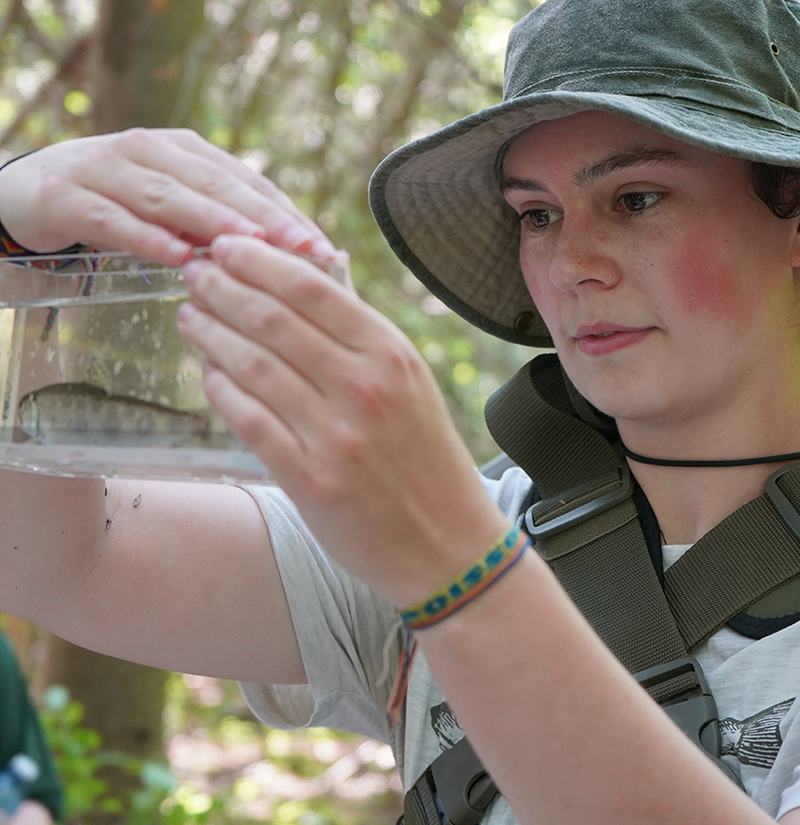
Want to build?expertise?in more than one area of environmental science without starting over??
If you’re?planning a career in environmental and natural resource sciences, choosing a program can feel like a big decision. You might be interested in ecosystem management but also want?to?gain?experience with fish and wildlife. Or?perhaps you’re?passionate about conservation and want to add specialized knowledge in biodiversity and research.
At Fleming College, you may not have to choose just one path.?
Through flexible?credit-transfer?pathways in the School of Environmental and Natural Resource Sciences (SENRS),?you can work?towards more than one?diploma with just two?additional?semesters of study.?
Ready to explore your options?
Start with one of these three programs and?discover?the?possibilities?of adding a second diploma.?
Conservation Biology?
Explore conservation challenges. Protect biodiversity.?
If? you’re?driven to understand and protect the plants, animals and ecosystems that make up our natural world, Conservation Biology combines field experience with laboratory science and applied research.?
The program focuses on biodiversity and conservation challenges, including the protection of native species and their habitats.?You’ll?explore how scientific information can be used to understand environmental changes,?monitor?species and habitats, and develop practical approaches to conservation.?
Biodiversity and conservation science:?Build?expertise?in species-at-risk conservation and habitat assessment.?
Cutting-edge?laboratory tools:?Gain familiarity with emerging technologies like environmental DNA (eDNA) and?conservation?genetics.?
- Scientific data analysis:?Learn how to collect and interpret data to protect native species and habitats.?
- Gain?experience:?Conservation Biology combines field and laboratory learning, giving you hands-on experience with wildlife surveys, habitat assessments, species identification, and biodiversity monitoring. In your final semester,?you’ll?apply your skills through an applied research project?working in Fleming’s living laboratories.?
- Career fit:?Depending on your interests, you?could?pursue roles such as Biological Technician, Conservation Technician, Aquatic Biology Technician, Fisheries Technician, Species at Risk Technician or Wildlife Resources Technician.?
Ecosystem Management Technician?
Monitor the environment. Protect the future.?
Want?to understand the bigger picture of how ecosystems work and how people interact with them??
The Ecosystem Management Technician program takes?a holistic approach?to environmental management.?You’ll?study the planet and how it functions while exploring how human activity affects the natural world and how environmental professionals can help address today's ecological challenges.?
The program incorporates elements of forestry, conservation biology, wildlife?management?and environmental assessment, giving you a broad understanding of ecological issues and practical approaches to addressing them.?
- Ecosystem fundamentals:?Study terrestrial, aquatic, and?restoration?ecology, environmental monitoring, and resource inventories.?
- Applied research methods:?Learn how to design environmental sampling procedures and address real-world ecological challenges.?
- Gain?experience:?This hands-on program?takes?your learning beyond the classroom.?You’ll?participate?in real-world monitoring projects, conduct field research,?and work in partnership with outside organizations.?A?mandatory two-week, 80-hour field placement?gives?you?the opportunity to apply your skills in a professional setting and gain valuable work experience.?
- Career fit:?Graduates?will?find opportunities with conservation authorities, not-for-profit organizations, consulting?firms?and government agencies, including organizations such as the Ministry of Natural Resources and Parks Canada.?
Fish and Wildlife Technician?
Fisheries, Wildlife, Habitat. Stewardship?in?action.?
If?you’re?passionate about fish,?wildlife?and the habitats they depend on, the Fish and Wildlife Technician program offers hands-on training to turn that interest into a career.?
You’ll?learn how professionals?monitor?and manage fish and wildlife populations, assess?habitats?and collect the information needed to support conservation and sustainable resource management. The program combines classroom and laboratory learning with extensive field experience, giving you the opportunity to develop practical skills in real-world settings.?
- Core ecological sciences:?Master practical skills and gain knowledge in fisheries, wildlife, and habitat management.?
- Population assessment techniques:?Build?expertise?in the specific methods used to?monitor?and evaluate fish and wildlife populations.?
- Sustainable resource strategies:?Learn how to analyze data to support ongoing conservation and resource management goals.?
- Gain?experience:?If you learn best by?doing,?you’ll?have plenty of opportunities to put your skills to work. A key part of the program is the?immersive?five weeks of field schools, where you’ll develop practical skills?and?gain experience in?boat handling, live trapping, fish netting, sampling and tagging, electrofishing, habitat assessment, wetland classification, bird banding, use of wildlife monitoring technologies, and so much more.?
- Career fit:?Graduates can find opportunities with government agencies, conservation organizations, consulting firms, non-profit?organizations?and other employers involved in the management and protection of fish, wildlife,?and their habitats.?
Build on Your First Diploma?
You?don’t?have to limit yourself to one area of environmental science. Fleming’s flexible pathways let you build on your first diploma, develop complementary skills, and work toward an?additional?credential without?starting from scratch.?
Whether your interests lie in conservation, fish and wildlife, or ecosystem management, you can create an educational path that reflects your career goals.?
Explore SENRS?programs today?and?map out a dual-credential?pathway that’s right for you.?
Quick Links?to SENRS Program Pages:?
- Conservation Biology?
- Ecosystem Management Technician?
- Fish and Wildlife Technician (Optional Co-op)
More information:
communications@flemingcollege.ca
Last week, we hosted a Webinar Wednesday session shining a spotlight on our Ecosystem Management Technician program. If you couldn’t join us virtually, don’t worry. Below are the highlights from the session, along with the full recording below to watch at your convenience.
Fleming College’s Ecosystem Management Technician program, within the School of Environmental and Natural Resource Sciences is defined by hands-on fieldwork, applied research, and a strong focus on student growth and support. During the webinar, prospective students heard from Brooke Lynch in Student Recruitment and Josh Feltham, Program Coordinator, about what the program looks like in practice, including field-based learning, long-term environmental monitoring projects, study abroad opportunities, applied research on campus and in the community, and the wide range of career and further education pathways available after graduation.
Why Ecosystem Management Technician at Fleming?
If you are passionate about the environment and want a career that makes a real difference, this program is designed to give you the skills and experience you need. Students spend a significant amount of time outdoors learning how to monitor ecosystems, collect environmental data, and study wildlife and habitats.
Through a combination of classroom learning and field-based labs, you will explore topics such as ecology, terrestrial and aquatic ecosystems, environmental monitoring, and restoration practices. You will also gain hands-on experience using industry tools and techniques to assess environmental conditions and support conservation initiatives.
Throughout the program, students participate in applied research projects and environmental initiatives on campus and in the community. There may also be opportunities to participate in international experiences, such as a semester abroad. By graduation, students leave with practical field skills, ecological knowledge, and problem-solving abilities that prepare them for careers in conservation, environmental monitoring, ecological restoration, or further studies in environmental science.
Three Key Takeaways
1. Ecosystem management is about sustaining both nature and people
Ecosystem management is about understanding how natural systems function and finding ways to protect them while supporting human communities. Students learn to think about sustainability in a broad way, considering environmental, social, economic, and cultural factors when making decisions. This approach helps future professionals develop solutions that support both ecosystems and the people who depend on them.
2. Hands-on fieldwork builds real-world environmental skills
One of the most exciting aspects of the program is the opportunity to learn directly in the field. Students work in forests, wetlands, lakes, and other ecosystems to collect and analyze data. They may monitor wildlife populations, assess water quality, study plant communities, or contribute to long-term environmental research projects. These experiences help students build the technical and practical skills needed for careers in environmental management.
3. Solving environmental challenges requires collaboration and adaptability
Environmental issues are complex and often involve multiple stakeholders. In the program, students learn how to work with communities, organizations, and researchers to address environmental challenges. Communication, collaboration, and adaptability are essential skills that help graduates develop solutions that are effective and sustainable over the long term.
CHECK OUT THE FULL WEBINAR:
HAVE QUESTIONS OR WANT TO LEARN MORE?
If this session sparked your interest or you’re considering a future as an ecosystem management technician, we’d love to connect with you. Our Student Recruitment team and program representatives are here to answer questions, help you explore admission pathways, or guide you toward the right next step. Be sure to check out our upcoming Webinar Wednesday sessions online. We’re hosting new topics in the months ahead and it’s a great way to learn more about programs that excite you.
CAN’T?MAKE A LIVE WEBINAR WEDNESDAY EVENT??
No problem! We’ll save video recordings on Fleming’s official YouTube channel. And?don’t?worry, Program Coordinators are always available to answer your questions!???
For more information about Webinar Wednesdays, please contact Student Recruitment.?
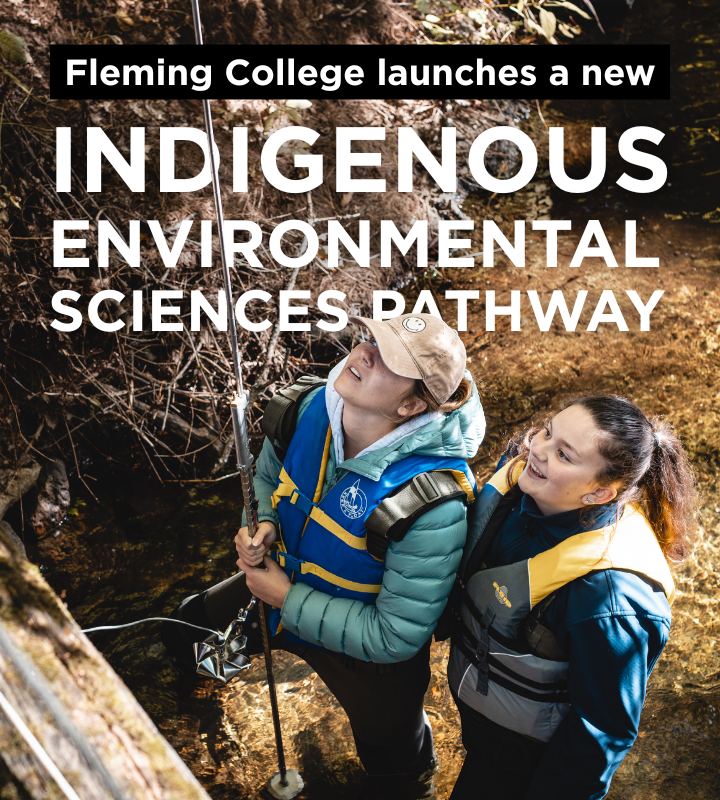
Peterborough, ON – (August 14, 2025) – A new pathway program at Fleming College is opening doors for Indigenous learners interested in pursuing careers in environmental and natural resource sciences.
Launching on September 15, 2025, the Indigenous Environmental Sciences (IES) Pathway offers a supportive and accessible transition into college, with no high school diploma required for admission and no tuition costs for Indigenous students. Delivered through a combination of online and in-person classes at Fleming’s Sutherland campus in Peterborough, the pathway provides a supportive, small-class learning environment designed to help students succeed.
This program reflects the college’s commitment to reconciliation and education by creating an inclusive space where Indigenous learners can thrive and explore meaningful careers in environmental stewardship.
Upon successful completion, students will be eligible to enter a range of diploma and certificate programs within Fleming’s School of Environmental and Natural Resource Sciences (SENRS), including:
In addition to gaining up to five transfer credits, graduates of the IES Pathway program will be well-prepared academically and supported holistically through services offered by Indigenous Student Services and Fleming’s academic departments.
Applications are now open, and spaces are limited. To learn more or to apply, visit:
https://flemingcollege.ca/indigenous-environmental-sciences-pathway or contact IES@flemingcollege.ca
About Fleming College
Fleming College respectfully acknowledges that we are situated on Michi Saagiig Anishinaabeg lands and territory. Located in the heart of Central Ontario, Fleming College has campus locations in Peterborough, Lindsay, Cobourg and Haliburton. Named for famous Canadian inventor and engineer Sir Sandford Fleming, the college features more than 85 full-time programs in Arts and Heritage, Business, Environmental and Natural Resource Sciences, General Arts and Sciences, Health and Wellness, Justice and Community Development, Skilled Trades and Technology, and Continuing Education. Fleming College has more than 8,500 full-time and 445 part-time students, and 95,000 alumni.
For more information, please contact:
IES@flemingcollege.ca
For media inquiries, please contact:
Elise Moore
Communications Officer
Elise.moore@flemingcollege.ca
Find us online:
Web: flemingcollege.ca
Facebook: facebook.com/flemingcollege
X: @FlemingCollege on Twitter
Instagram: @flemingcollege on Instagram
TikTok: @flemingcollege on TikTok
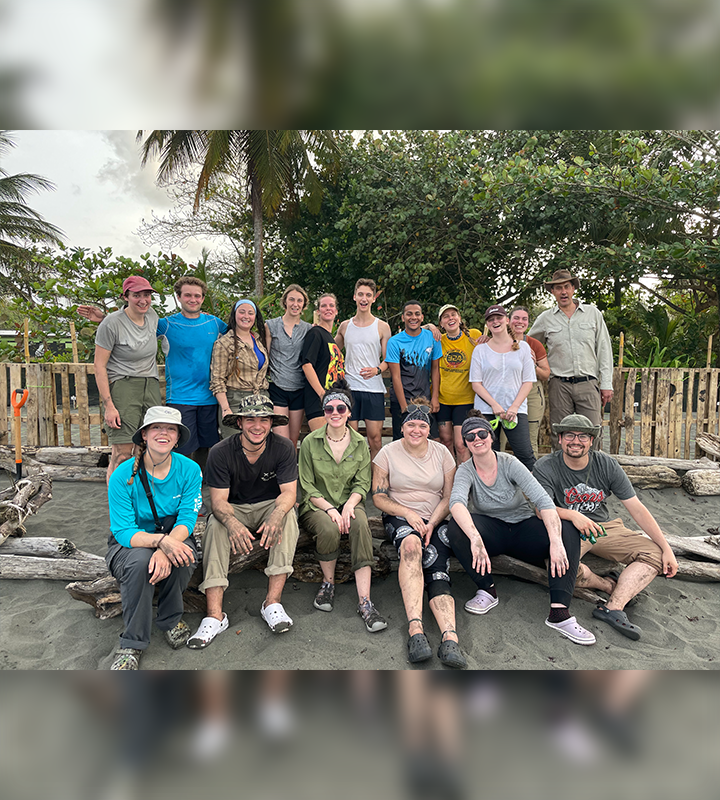
Peterborough, ON (November 6, 2023) - Each spring, Fleming College students can be found walking the beaches of Parismina, a small village south of Tortuguero National Park, often in the middle of the night.
This is Turtle Patrol. And it’s part of a larger effort by Fleming Ecosystem Management Technician and Ecosystem Management Technology students and Parismina, Costa Rica residents to save the leatherback turtle, one hatchling at a time.
It is a long trek from Frost Campus in Lindsay Ontario to the village of Parismina. Fleming students have been making the journey for a decade now as part of a long-standing partnership with the Asociacion Salvemos las Tortugas de Parismina (ASTOP) project.
“Fleming College strives to provide its students with a deep sense of community and responsibility to the world around them,” said Fleming College President Maureen Adamson. “This type of educational experience is a demonstration on how broad that community can be, and how we can help a community hundreds of kilometres away.”
ASTOP was founded after Parismina residents noticed a significant decline in the population of leatherback turtles on local beaches, and the impact that was having on the ecosystem right outside their doors.
Listed as a critically endangered species, leatherback turtles can be found around the world, though populations in different oceans are considered distinct.
Fleming students work with the turtles from the Atlantic population, which have key nesting habitats in Mexico and Costa Rica. These creatures have seen a population decline of about 90% since the 1980s. The World Wildlife Fund attributes the decrease to several factors, including habitat loss and “byfishing” operations-using nets and fishing lines which migrating turtles get caught in.
Poaching turtle eggs is one of the biggest threats to the species. Despite legislation prohibiting the collection of these eggs, hundreds of thousands of leatherback turtle eggs are stolen from nests each year for consumption or sale.
Fleming College students are working to change that.
This spring a dozen Ecosystem Management Technician and Ecosystem Management Technology students arrived in Parismina to monitor the beaches each night for two weeks in late April.
Working alongside trained guides in shifts from 8 p.m. to midnight and midnight to 4 a.m., these nighttime turtle patrols serve two purposes-deterring potential poachers and watching for nesting turtles.
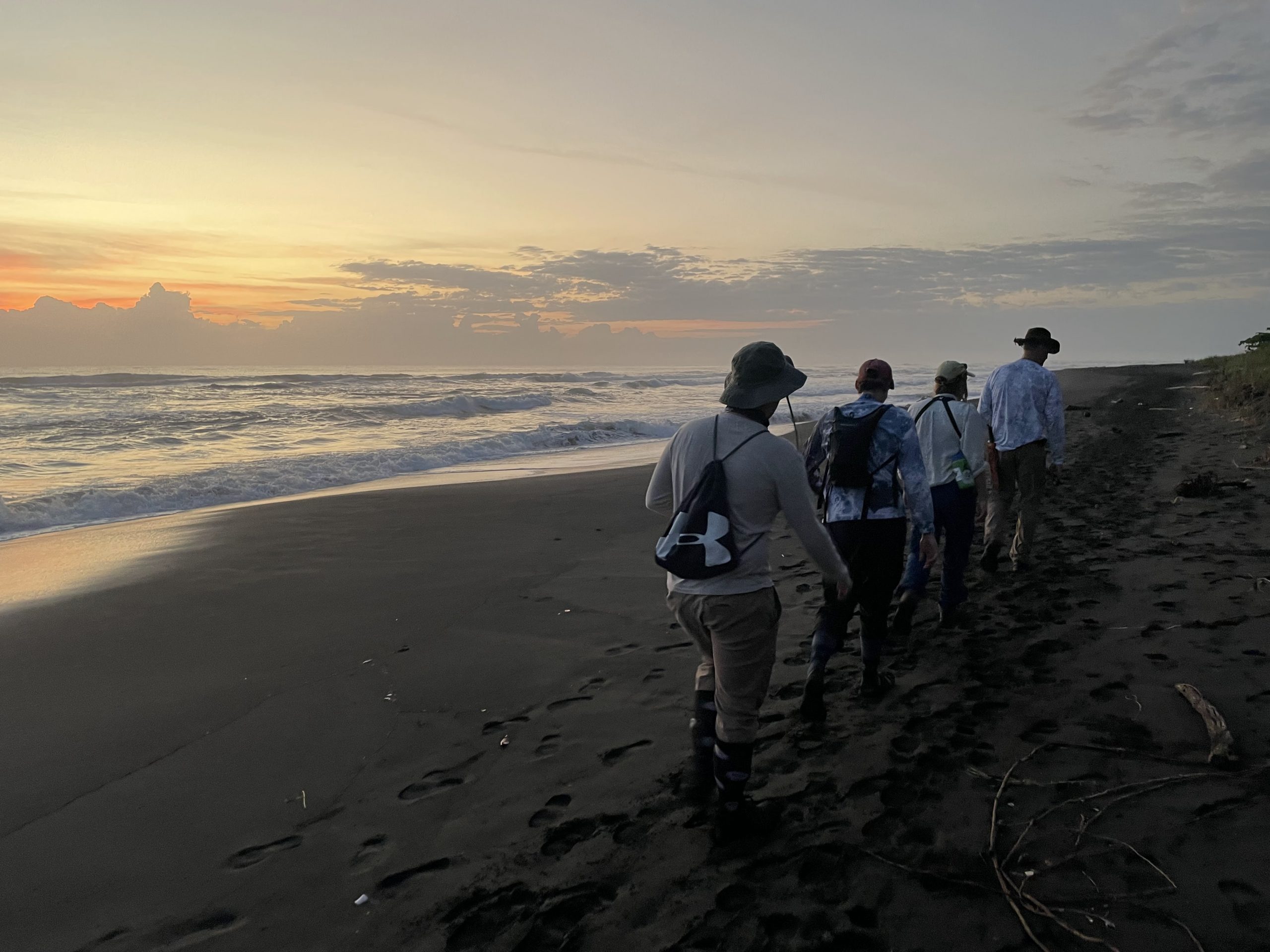
If students find a turtle, they help determine if she has already laid her eggs or is just starting the nesting process. Once the nesting process is complete, students move in.
Eggs are collected, taken to a protected hatchery on the beach and reburied in the sand.
No detail is overlooked. Students measure the length, depth, and width of the turtle’s original nest so they can accurately replicate it in the hatchery. Eggs are guarded until they are ready to hatch about two months later. This year, students added another layer of protection to the hatchery by building a fence along its perimeter.
“These students are learning that an effective solution which helps both community members and their environment means paying attention and listening to the needs of that community, and coming up with best practices that benefits everyone,” President Adamson said.
“Our students are passionate about protecting the environment and learning about the natural world. These types of experiences, found through Fleming College, gives our students a chance to use their knowledge and skills to improve the world around us.”
Fleming College will return to Parismina in April 2024.
The College’s Frost Campus hosts programs dedicated to environmental and natural resource studies, including Conservation Biology, Ecosystem Management Technician, Ecosystem Management Technology, Urban Forestry and Sustainable Agriculture, to name a few.
To learn more about the Frost Campus visit here.
About Fleming College
Fleming College respectfully acknowledges that we are situated on Michi Saagiig Anishinaabeg lands and territory. Located in the heart of Central Ontario, Fleming College has campus locations in Peterborough, Lindsay, Cobourg and Haliburton. Named for famous Canadian inventor and engineer Sir Sandford Fleming, the college features more than 100 full-time programs in Arts and Heritage, Business, Environmental and Natural Resource Sciences, General Arts and Sciences, Health and Wellness, Justice and Community Development, Skilled Trades and Technology, and Continuing Education. Fleming College has more than 6,800 full-time and 10,000 part-time students, and 80,000 alumni.
For media enquiries, please contact:
Sarah Deeth
Communications Officer
sarah.deeth@flemingcollege.ca
705-749-5530 ext. 1161
Web: flemingcollege.ca
Facebook: facebook.com/flemingcollege
Twitter: @FlemingCollege on Twitter
Instagram: @flemingcollege on Instagram