Hands-On Learning Helped Paige Andrews Build a Career in Aquaculture
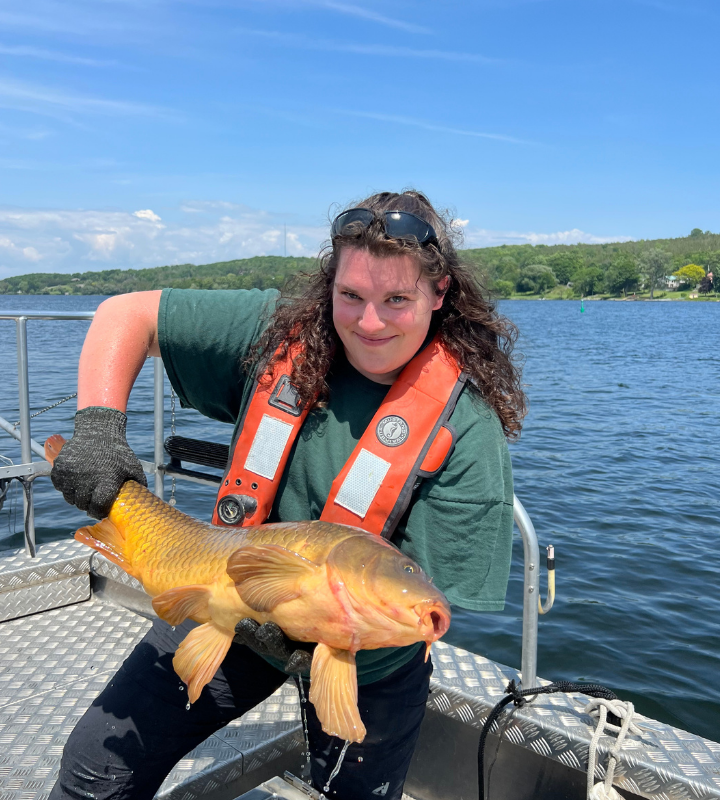
When Paige Andrews graduated from Fleming College’s Aquaculture program in 2026, she left with more than technical knowledge. She gained hands-on experience, leadership skills, and the confidence to succeed in a career working with aquatic species.
After completing Fleming’s Fish and Wildlife program, Paige wanted to continue learning about fish while gaining even more practical experience.
“I wanted another program related to fish with lots of hands-on experience, and Aquaculture seemed like the perfect fit. I wanted to learn more about one of the biggest parts of the food industry while expanding my knowledge of water quality, fish stressors, and proper husbandry techniques,” she says. “I also knew there were always jobs available in this field.”
One of the things that stood out most about the program for Paige was the amount of time students spent learning by doing. Three out of four school days were spent working in the Fleming Hatchery, giving students the opportunity to experience the day-to-day responsibilities of a working hatchery.
“The hands-on experience was one of the most valuable parts of the program,” says Paige. “Practicing these skills every day helped reinforce what we were learning in class and gave us confidence for the workplace.”
Another favourite experience was the Manager for a Week assignment. Each student took a turn leading their classmates, assigning daily tasks, and responding to a simulated emergency.
“It gave me a real understanding of how a hatchery operates and what it’s like to make decisions when unexpected situations come up,” she says. “It was a great way to build leadership skills in a real-world setting.”
After graduating, Paige completed a co-op placement with the Ministry of Natural Resources (MNR) at the Lake Ontario Management Unit in Picton. During her placement, she had the opportunity to participate in fingerling stocking alongside MNR hatchery staff and apply what she had learned in the classroom.
“The program has been incredibly valuable in my current role, where I lead an eel trap and transfer program,” she says. “Understanding fish stress, dissolved oxygen levels, fish diseases, and even mechanical systems helps me every day. The skills I learned at Fleming continue to be part of the work I do.”
For anyone thinking about pursuing Aquaculture, Paige encourages students to make the most of every opportunity.
“Don’t be afraid to step outside your comfort zone and ask questions,” she says. “Make as many connections as you can because you never know who you’ll meet later in your career. Most of all, take advantage of the hands-on experience. Not many programs offer this much practical learning, and it’s one of the best ways to prepare for your future.”
The School of Environmental and Natural Resource Sciences at Fleming College is very proud of its graduates, and Paige is a great example of how the Aquaculture Graduate Certificate Program (Co-op) can not only lead to opportunities around the world, but one that allows for many different career paths.