Graphic Design - Visual Communication
Delivered at our campus in Peterborough, this is one of the few two-year advanced diploma programs of its kind offered in Ontario. In this intensive, compressed program, three years of study is completed over a two-year period. Graduates are ready to start their graphic design careers in just 24 months.
Program Information
Start Date
September 07, 2027
Domestic Availability
Accepting Applications
International Availability
Coming Soon
CIP Code
50.0409
Program Code
GDV
Delivery
In Person, Placement
Credential
Ontario College Advanced Diploma
Academic School
Location
Program Contact
Domestic Tuition
per semester*
International Tuition
per semester*
*Domestic tuition amounts shown are from the 2026-2027 academic year and are subject to change.
*International tuition amounts shown are from the 2026-2027 academic year and are subject to change.
Apply Now
Canadian StudentsView Curriculum
Students in this accelerated program learn and work in a unique, contemporary design studio space; in this “classroom as design lab and studio,” they discover what it takes to become a professional designer, and how to thrive in this fast-paced industry.
Students gain the skills and understanding required to communicate ideas in digital and printed media through extensive and varied applied learning experiences. At the end of six continuous semesters, they are fully prepared to hit the ground running, ready to launch their design careers in any industry that requires creative problem solving through visual communication.
In this program you will:
- Learn in a laptop-based environment which provides maximum flexibility to work offsite as well as in class.
- Experience the design studio model that emphasizes collaboration, communication and experimentation – skills that are highly valued by employers.
- Develop and build your art, design and technical skills in modular small projects, working towards comprehensive collaborative projects to further test your abilities.
- Live the life of a designer, working independently and with your team, on an ambitious, large- scale project that requires branding, diverse multi-media graphic materials. This will include projects across a full range of media and platforms including print publications, advertising, web, mobile, social media, signage and environmental graphics.
- Gain additional, hands–on experience with an extensive work placement in a design studio, agency, or in–house design department.
- Understand how art fundamentals and principles inform successful design.
- Learn from our expert faculty as well as designers who are shaping today’s industry.
- Graduate with a substantial portfolio, and the ability to prepare and deliver effective presentations.
Fleming College’s Haliburton School of Art + Design is known for providing innovative art and design programming. Offered at our campus in Peterborough, this advanced diploma program is structured to simulate the setting and pace of a real-world design environment to prepare students to enter the workforce faster, fully-prepared to be successful.
There is a high demand for graphic designers and career opportunities in the industry are diverse.
Career Settings
Potential career settings include:
- advertising
- branding agencies
- graphic design studios
- package design studios
- retail advertising
- in-house design departments in large and medium sized enterprises
- not-for-profit and government agencies
- marketing firms
- self-employment
Areas of Specialty
Areas of specialty include:
- branding and corporate identity
- advertising
- digital
- interactive
- environmental
- exhibition
- packaging
- book design
| Fees | Semester 1 | Semester 2 | Semester 3 | Semester 4 | Semester 5 | Semester 6 |
|---|---|---|---|---|---|---|
| Tuition | $1454.98 | $1454.98 | $1454.98 | $1454.98 | $1454.98 | $1454.98 |
| Academic Fees | $1215.85 | $990.85 | $990.85 | $1215.85 | $990.85 | $990.85 |
| Material Fees | $470.00 | |||||
| Field Trip Fees | $413.00 | |||||
| Total | $3140.83 | $2445.83 | $2445.83 | $3220.83 | $2445.83 | $2445.83 |
- Conceptualize and develop design solutions using principles of design to create visual communications that meet the needs of the project.
- Employ the design process to create design solutions that meet the project objectives and the needs of the client and/or user.
- Plan, create and use photography, illustration and typography in design layouts to meet the requirements of the creative brief.
- Design, develop and create a variety of media products using relevant, current and/or emerging technologies.
- Communicate ideas, design concepts and opinions clearly and persuasively to others.
- Use recognized industry practices throughout the design process and related business tasks.
- Plan, implement, and evaluate graphic design projects using project management skills to deliver quality work to clients according to schedule and within budget.
- Complete all work in a professional and ethical manner, and in accordance with all applicable legislation and regulations.
- Keep current with visual media design trends, technologies and industry practices using strategies that enhance work performance and guide professional development.
Students applying to Graphic Design - Visual Communication must meet the following requirements:
- OSSD including Gr 12 C English
- MacBook Pro, 13 inch (minimum)
- Adobe Creative Suites, Creative Cloud Student and Teacher Edition
- External HD, 1TB (minimum)
- USB Flash Drive, 32GB (minimum)
- iPhone 5c or Smart Phone 32GB
Transfer Agreements
You may be able to use credits obtained at Fleming College to continue your postsecondary education in pursuit of a degree. The articulation and credit transfer agreements with our partner institutions are summarized here.
Bachelor of Design in Visual Communication Design (3YR)
Requirement
- Minimum 65% cumulative program average.
- The program is offered face-to-face (Gold Coast campus or South Bank campus).
Transfer Credit
- 160 credit points out of a 240-credit point degree.
- Refer to the articulation agreement for further details.
To apply please see the Griffith University's admissions website.
For more information
Visit the Griffith University website for further articulation and program information.
See the official articulation agreement.
Bachelor of Design in User Experience
Requirement
- Minimum 65% cumulative program average.
- Possess ENG4U (Grade 12 University English) or equivalent with a course grade of 70%.
Transfer Credit
- 60 out of a 120-credit degree.
- Refer to ONTransfer.ca for further details.
To apply please see the Ontario Colleges website.
For more information
Visit the Humber Polytechnic website for further articulation and program information.
Visit the ONTransfer.ca website for agreement information.
Bachelor of Arts & Science in Media, Film, & Communications
Requirement
- Minimum 70% cumulative program average.
Transfer Credit
- 8.5 out of a 20-credit degree.
- Refer to ONTransfer.ca for further details.
To apply please see the Ontario Universities' Application Centre (OUAC) website.
For more information
Visit the Lakehead University website for further articulation and program information.
Visit the ONTransfer.ca website for agreement information.
Bachelor of Arts - General
Requirement
- Minimum mid-70% cumulative program average.
Transfer Credit
- 60 out of a 120-credit degree.
- Refer to OntarioTech's website for further details.
To apply please see the Ontario Universities' Application Centre (OUAC) website.
For more information
Visit the Ontario Tech University website for further articulation and program information.
Bachelor of Arts in Communication and Digital Media Studies
Requirement
- Minimum mid-70% cumulative program average.
Transfer Credit
- 60 out of a 120-credit degree.
- Refer to ONTransfer.ca for further details.
To apply please see the Ontario Universities' Application Centre (OUAC) website.
For more information
Visit the Ontario Tech University website for further articulation and program information.
Bachelor of Arts in Educational Psychology
Requirement
- Minimum mid-70% cumulative program average.
Transfer Credit
- 60 out of a 120-credit degree.
- Refer to OntarioTech's website for further details.
To apply please see the Ontario Universities' Application Centre (OUAC) website.
For more information
Visit the Ontario Tech University website for further articulation and program information.
Bachelor of Arts in Educational Studies and Digital Technology
Requirement
- Minimum mid-70% cumulative program average.
Transfer Credit
- 60 out of a 120-credit degree.
- Refer to ONTransfer.ca for further details.
To apply please see the Ontario Universities' Application Centre (OUAC) website.
For more information
Visit the Ontario Tech University website for further articulation and program information.
Bachelor of Arts in Psychology
Requirement
- Minimum mid-70% cumulative program average.
Transfer Credit
- 60 out of a 120-credit degree.
- Refer to Ontario Tech's website for further details.
To apply please see the Ontario Universities' Application Centre (OUAC) website.
For more information
Visit the Ontario Tech University website for further articulation and program information.
Bachelor of Arts in Sociology, Technology and Innovation
Requirement
- Minimum mid-70% cumulative program average.
Transfer Credit
- 60 out of a 120-credit degree.
- Refer to OntarioTech's website for further details.
To apply please see the Ontario Universities' Application Centre (OUAC) website.
For more information
Visit the Ontario Tech University website for further articulation and program information.
Bachelor of Commerce
Requirement
- Minimum mid-70% cumulative program average.
- Completion of the Ontario Tech Commerce Bridge.
Transfer Credit
- 45 out of a 120-credit degree.
- Refer to ONTransfer.ca for further details.
To apply please see the Ontario Universities' Application Centre (OUAC) website.
For more information
Visit the Ontario Tech University website for further articulation and program information.
Bachelor of Arts in Professional Communication
Requirement
- Minimum B cumulative program average.
Transfer Credit
- Entry into 3rd-year studies of a 4-year program.
- Refer to the articulation agreement for further details.
To apply please see the Royal Roads University's admissions website.
For more information
Visit the Royal Roads University website for further articulation and program information.
See the official articulation agreement.
Bachelor of Interdisciplinary Studies
Requirement
- Minimum 65% cumulative program average.
Transfer Credit
- Entry into 5th semester standing in an 8-semester program.
- Refer to Seneca College's website for further details.
To apply please see the Ontario Universities' Application Centre (OUAC) website.
For more information
Visit the Seneca Polytechnic website for further articulation and program information.
Visit the ONTransfer.ca website for agreement information.
See the official articulation agreement.
Bachelor of Arts
Requirement
- Minimum 75% cumulative program average.
Transfer Credit
- 7 out of a 20-credit degree (Cohort: Fall 2023 - Present).
- Refer to ONTransfer.ca for further details.
To apply please see the Ontario Universities' Application Centre (OUAC) website.
For more information
Visit the Trent University website for further articulation and program information.
Visit the ONTransfer.ca website for agreement information.
See the official articulation agreement.
Bachelor of Science
Requirement
- Minimum 75% cumulative program average.
Transfer Credit
- 7 out of a 20-credit degree (Cohort: Fall 2023 - Present).
- Refer to ONTransfer.ca for further details.
To apply please see the Ontario Universities' Application Centre (OUAC) website.
For more information
Visit the Trent University website for further articulation and program information.
Visit the ONTransfer.ca website for agreement information.
See the official articulation agreement.
Watch our Webinar Wednesday Recording
In The News: Graphic Design - Visual Communication
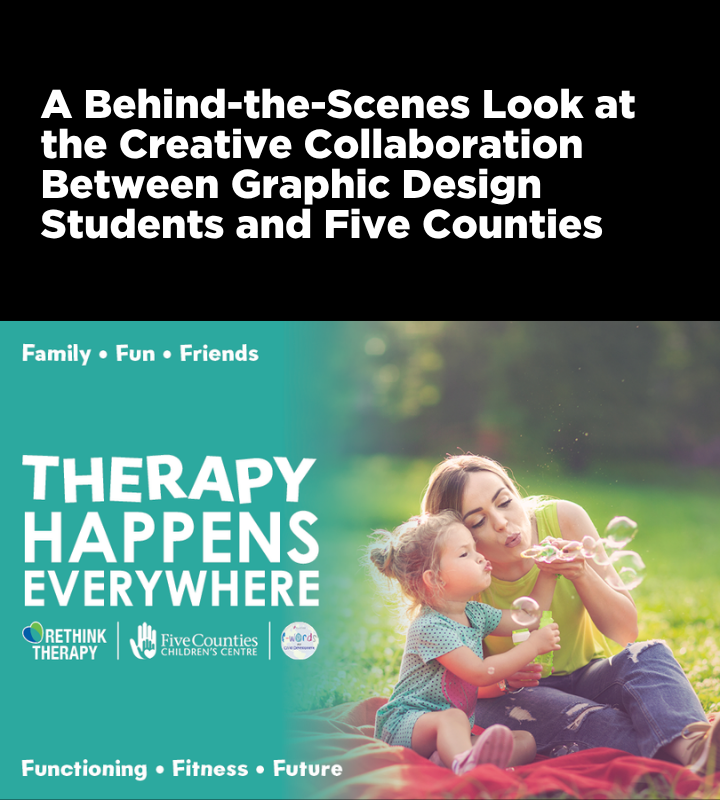
In March 2026, Fleming College celebrated a unique partnership between our Graphic Design–Visual Communication (GDV) program and Five Counties Children’s Centre. Students Taylor Polley and Austin Lane took on the challenge of developing "Rethink Therapy," an awareness campaign designed to educate parents that progress and growth happen everywhere, not just in a clinical setting.
This project served as a vital bridge between the classroom and the workforce, allowing students to apply their skills to a professional-level project with real-world community impact. We sat down with Taylor and Austin to discuss the creative grind, the intimidation of client presentations, and the pride of seeing their designs come to life.
Q. Can you explain the heart of this project?
Austin: Five Counties Children's Centre reached out to Fleming College in 2025 to work with our class on an integrated multimedia campaign based on "caregiver coaching". This entailed building a campaign from the ground up to show students what working with real-world clients would be like.
Taylor: We were given a brief stating that Five Counties wanted a campaign to make parents aware of the crucial role they play in their child's treatment success. From there, we learned, designed, and produced the ideas that eventually inspired the Rethink Therapy campaign.
Q. How was working with a community client different from a typical classroom assignment?
Taylor: It was very different because research was left entirely up to the students, whereas in class most information is given to you. This campaign had to impress a much wider audience, including our professors, the client, and the client's target audience.
Austin: It was challenging in a good way. It was definitely a different feeling presenting in front of a community client; it felt incredibly important, which was a bit intimidating. Ultimately, that helped prepare us for presentations with future clients.
Q. Walk us through the creative process. How did you get from a brief to a final campaign?
Austin: We began with a brief and preliminary research to come up with early logo ideas and sketches. One sketch used two circles: a large one to represent the parent and a smaller one for the child.
Taylor: I also explored designs using hands similar to the Five Counties logo to represent unity between the parent, the child, and the clinic. We met with the staff to ask questions and get a feel for what they were looking for.
Austin: Once the interview portion was finished, we used our accumulated knowledge to refine our ideas to match the overall message. We spent a lot of time refining the logo, the tagline, and the name of the campaign because we really wanted to nail the concept.
Taylor: Once we found our core design elements like colour and imagery, everything began to fall into place. After the lead creative was finished, we worked on deliverables like posters, social media posts, and website designs.
Q. What was the biggest hurdle you faced during the "grind"?
Taylor: I felt that one of the biggest challenges was the naming of the campaign. We wanted it to capture the essence of caregiver coaching while being short and easy to interpret. We actually put off giving the campaign a name for a while to give us time to resonate more with the design.
Austin: A lot of the challenges came in the form of refining ideas. We would reach a point where we felt like it needed something, but we didn't always know what that something was. This led us to make multiple variations, often very similar to one another, to find the missing piece.
Q. Were there specific moments where you felt especially proud of the work?
Austin: I felt that everything was really coming together when we were working with the gradient for some of the posters and media. We had all the important aspects sorted out, and all that was left was organizing those ideas.
Taylor: There were two main points in the project that made me proud of the work I was doing: the initial meeting with Five Counties Staff and the design development stage.
During our first meeting, we were getting a feel for what the project should encompass. The Five Counties Staff educated Austin and me about their role in the therapy process. Hearing them talk so passionately about their mission gave me an overwhelming appreciation for the project we were about to embark on.
The second time I recall feeling especially proud when we were choosing imagery to go along with the design. We wanted to use photos that were relatable to families everywhere. Carefully choosing each image with intention gave me a sense of pride because it provides representation to children and their caregivers.
Q. What advice would you give to future students taking on a community client project?
Taylor: Information, information is key. Research and learn everything there is to know about the client, because the more you understand their audience, the more successful you will be. Have fun, look at intimidating projects such as these with optimism, you are learning, you are a student, and this will help you greatly with future endeavours.
Austin: When drafting ideas, try to make a broad spectrum of iterations. Really think outside the box about how you can express the content. Don't be afraid to draft an idea you are unsure of, as it may end up being the best one you come up with.
Q. How has this studio experience shaped your goals for life after Fleming?
Austin: It helped me understand that there are many different ways to incorporate my knowledge into so many different kinds of careers. One of my goals is to stay creative and do personal projects. Another goal is to carry my knowledge of art and graphic design into any future career, even if the career itself is not art-focused. In my current career working as an eyewear consultant, I use my knowledge of colour to help pair clients with the perfect pair of glasses.
Taylor: During my time at Fleming, I honed my technical and creative abilities. I learned what I liked about design and how to communicate ideas through it. Before my time at Fleming, I was unsure about what I wanted my future to look like. As soon as I stepped into the GDV Studio, I knew I wanted to become a Graphic Designer. I now want to be a successful designer and make art my career.ore satisfying. That’s what truly motivates anyone who’s in it for the long haul; the pursuit, the striving, the questions, the process. Those are the true rewards.

Last week, we hosted a Webinar Wednesday session highlighting our Graphic Design – Visual Communication (GDV) program. If you couldn’t join us live, don’t worry. Below are some key takeaways from the session, along with the full recording available to watch at your convenience.
Fleming College’s Graphic Design program offers students an immersive, hands-on creative education focused on storytelling, branding, digital media, design strategy, and real-world client work. During the webinar, prospective students connected with Matt Thompson from Student Recruitment and Anita Matusevics, Program Coordinator, to learn more about the studio environment, student projects, internship opportunities, career pathways, and the evolving future of design.
Why Graphic Design at Fleming?
Our graphic design program is an accelerated advanced diploma program completed in just two years. The program runs continuously through the summer, allowing students to graduate faster and enter the workforce sooner.
Students learn through a project-based, studio-style environment that mirrors a professional design studio rather than a traditional classroom. Throughout the program, students work on real-world creative challenges across print, digital, branding, storytelling, motion graphics, web design, typography, photography, and experiential design.
The program is designed to help students think creatively, communicate visually, and develop the technical and strategic skills needed in today’s design industry. Faculty members are all practicing professional designers, ensuring students are learning current tools, workflows, and industry best practices.
Three Key Takeaways
1. Hands-on, Project-Based Learning from Day One
The program is built around applied learning through projects instead of traditional exams or tests. Students gain experience working on branding campaigns, posters, web design, illustration, editorial layouts, typography, packaging, social media campaigns, photography, and motion graphics projects.
Students are encouraged to experiment creatively while also learning industry-standard tools like Adobe Creative Suite alongside emerging technologies and platforms. The curriculum combines technical skill development with creative problem solving and visual storytelling.
The studio environment also emphasizes observation, collaboration, communication, and design thinking, helping students learn how to approach challenges like professional designers.
2. Real-World Experience Through Community Client Work and Internships
A major highlight of the program is the opportunity to work directly with community clients on meaningful design campaigns. Students collaborate with nonprofit organizations and community partners on projects related to mental health, accessibility, homelessness, children’s services, arts organizations, and more.
Past community partners have included organizations such as United Way Peterborough & District, the Alzheimer Society, Five Counties Children’s Centre, and Peterborough Folk Festival. In many cases, student work has been implemented in real campaigns, with some students even securing internships and employment opportunities through these partnerships.
The final semester also includes an internship component where students gain professional work experience in real design environments. Fleming has maintained a strong record of helping eligible students secure internships with agencies, organizations, and businesses.
3. A Creative Career with Diverse Opportunities
Graphic design continues to evolve rapidly across industries, with opportunities spanning branding, advertising, web design, social media, motion graphics, UX/UI design, publication design, illustration, content creation, and more.
During the webinar, Anita discussed how design is increasingly connected to digital experiences, storytelling, strategy, and emerging technologies. Students graduate with versatile creative and technical skills that can adapt across many industries and career paths.
The webinar also addressed questions about artificial intelligence and design careers. Rather than replacing designers, AI is viewed as another creative tool that supports the design process. Human creativity, communication, storytelling, strategy, and emotional understanding remain essential components of successful visual communication. Graduates may choose to enter the workforce immediately, start freelance or entrepreneurial ventures, or continue their education through pathways into university degree programs in areas such as communication, media, design, or marketing.
LEARNING BEYOND THE CLASSROOM
Students in the program also participate in a second-year design research trip to Montreal, where they explore museums, exhibitions, installation design, and emerging creative technologies. The experience helps inspire and inform their own exhibition and design projects back in the studio.
Another unique aspect of the program is that no portfolio is required for admission. The program welcomes students from many different backgrounds and experiences who are looking to explore their creativity and develop new skills in a supportive, collaborative environment.
CHECK OUT THE FULL WEBINAR:
HAVE QUESTIONS OR WANT TO LEARN MORE?
If this session sparked your interest or you’re considering a future in graphic design, we’d love to connect with you. Our Student Recruitment team and program representatives are here to answer questions, help you explore admission pathways, or guide you toward the right next step. Be sure to check out our upcoming Webinar Wednesday sessions online. We’re hosting new topics in the months ahead and it’s a great way to learn more about programs that excite you.
CAN’T?MAKE A LIVE WEBINAR WEDNESDAY EVENT??
No problem! We’ll save video recordings on Fleming’s official YouTube channel. And?don’t?worry, Program Coordinators are always available to answer your questions!???
For more information about Webinar Wednesdays, please contact Student Recruitment.?
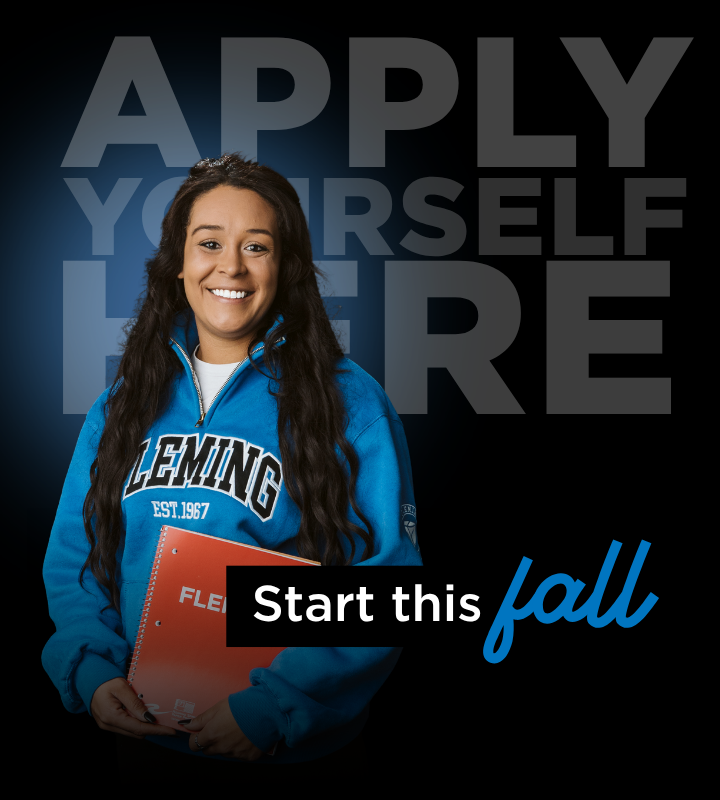
If you’re planning to start college this fall, there’s still time to apply to select programs at Fleming College and secure your spot for September 2026.
Why starting this fall is a smart move
Fall is one of the most exciting times to begin your college experience. From welcoming campus events to hands-on learning opportunities, starting in September sets you up for success from day one. You’ll have the chance to join in on the excitement of Orientation, student events, varsity sports, clubs, and campus activities alongside thousands of new students.
Six programs still accepting applications for Fall 2026:
- Developmental Services Worker (DSW): Make a meaningful difference by supporting individuals in social service, community, and healthcare settings through inclusive and person-centered care. Gain hands-on placement experience and graduate ready to work in community and support settings.
- Police Foundations: Build the knowledge and practical skills needed for careers in policing, community safety, and justice services. Train in areas including investigations, fitness, communication, and Canadian law.
- Blasting Techniques: Train in Canada’s only college blasting program and develop specialized skills for careers in mining, construction, drilling, and resource sectors using industry-standard equipment and facilities.
- Mechanical Techniques – Plumbing: Learn the fundamentals of plumbing systems, pipefitting, and mechanical installations through hands-on shop experience that prepares you for apprenticeship pathways and skilled trades careers.
- Computer Security and Investigations (CSI): Prepare for a career in security, investigations, and public safety through hands-on training in surveillance, risk assessment, interviewing techniques, and cybersecurity fundamentals. Gain practical skills for a rapidly growing field focused on protecting people, information, and organizations.
- Graphic Design – Visual Communication: Turn your creativity into a career while building skills in branding, digital media, illustration, typography, and design software used throughout the industry. Graduate with a professional portfolio that stands out.
Don’t miss your chance to start this fall
Your future doesn’t have to wait. Apply now for Fall 2026 and take the next step toward a rewarding career, hands-on learning, and an unforgettable college experience. Visit the program pages above to apply or explore more fall offerings here.

Taylor Polley and Austin Lane, students from Fleming College’s Graphic Design–Visual Communication program, are bringing real-world impact to the Peterborough community with the launch of Rethink Therapy, a new awareness campaign created for Five Counties Children’s Centre. This partnership highlights Fleming’s commitment to applied, community-engaged learning and skill development through invaluable professional-level projects, all while highlighting a powerful message that children’s therapy doesn’t just happen in a clinical setting.
Fleming is proud to partner with organizations like Five Counties who help bridge the gap between the classroom and the workforce. Not only is it a chance for students to strengthen their skills and gain work experience, it also provides opportunities for our students to make a difference in workplaces and communities.
Learn more:
More information:
communications@flemingcollege.ca
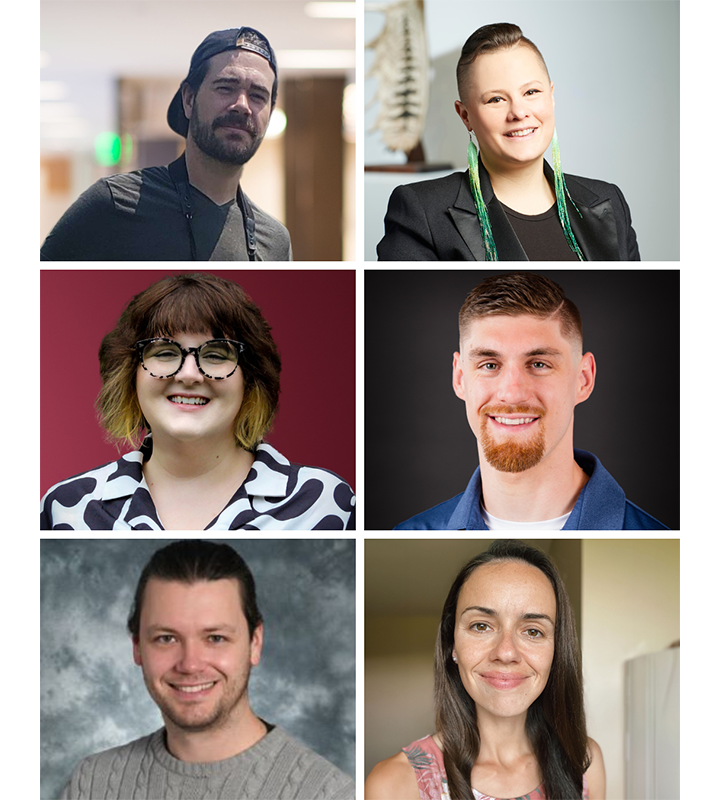
Peterborough, ON (October 4, 2024) – Six Fleming College alumni have been selected as nominees for the distinguished Premier’s Awards this year.
Founded in 1992, the Premier’s Awards are administered by Colleges Ontario, the advocacy voice for Ontario’s 24 colleges.
This annual celebration recognizes the important social and economic contributions college graduates make on a provincial and global scale. Colleges can nominate alumni in seven categories: Skilled Trades, Business, Community Services, Creative Arts and Design, Health Sciences, Recent Graduate, and Science, Technology and Engineering.
The Fleming College nominees for 2024 are:
Skilled Trades
Dylan Stadtke: Mechanical Techniques Plumbing (2016), HVAC Technician (2018)
The co-owner of Pristine Plumbing Peterborough, Dylan’s business is thriving, reflecting his dedication to high professional standards and community involvement. In addition to two Fleming diplomas, Dylan completed the Construction Leadership Program at Fleming in 2022, demonstrating his commitment to leadership and excellence in his field. Beyond his professional achievements, Dylan is deeply committed to men’s mental health and is a strong proponent of promoting women in trades. His dedication to these important issues underscores his role as a leader and innovator in his industry.
Health Sciences
Francine Sam: Practical Nursing (2024)
Francine Sam began her nursing career while living in Australia where she was enrolled in university for nursing. She ended up moving to a rural village in northern Uganda where she did humanitarian work for seven years alongside her young family, caring for vulnerable children and their communities. It was through her experiences there that compelled her to further her education at Fleming College. Francine recently graduated as a Practical Nurse and was the Valedictorian of the School of Health and Community Services and is now working as a Registered Practical Nurse in the Emergency Department at her local hospital.
Community Services
Heather George: Museum Management and Curatorship (2008)
Heather George is an influential leader in the Canadian museum sector. As Executive Director of the Woodland Cultural Centre, she advocates for Indigenous perspectives and creates opportunities for Indigenous artists and curators. As the Past President of the Canadian Museum Association and current Vice President for the Indigenous Heritage Circle, Heather advances the Truth and Reconciliation Commission's Call to Action #67, urging museums to engage in reconciliation with Indigenous peoples. In 2021, she led a national review of museum policies in relation to the United Nations Declaration on the Rights of Indigenous Peoples (UNDRIP). This review involved Indigenous communities and museum professionals, culminating in recommendations to change sector standards and develop federal repatriation laws.
Science, Technology and Engineering
Matthew Wilson: Conservation Biology (2024)
In 2022, Matthew Wilson made a significant decision to leave his career in the shipping industry and return to school. He was driven by a desire to pursue a more meaningful path, he chose to focus on addressing the pressing environmental and natural world challenges facing our planet today. Matt has always had a deep passion for animals and nature. Over the years, he has worn many hats, including biologist, arboricultural field technician, and research assistant. Recently, Matt enrolled in the Conservation Biology Program at Fleming College, where he graduated as Valedictorian of the School of Environmental and Natural Resources. Driven by a strong desire to make a positive impact on our climate, Matt is committed to preserving our natural legacy for future generations.
Recent Graduate
Jacques Graveline: Business Administration-Marketing (2022)
Jacques Graveline was a Student Ambassador for Fleming Indigenous Student Services and Fleming Student Administrative Council. He graduated from Fleming College with an Advanced Diploma in Marketing in 2022 and has been extremely involved in the College since. Elected as Board Chair at Fleming SAC in 2023, he passionately advocates for students to ensure an exceptional college experience. Jacques is a leader in the Peterborough community, supporting the United Way homeless initiative and Dragon Boat Races for Breast Cancer, while creating and implementing marketing strategies as the Marketing Assistant at Bridges Peterborough. Jacques is currently the Governance and Advocacy Coordinator with the Fleming Student Administrative Council.
Creative Arts and Design
Aaron Robitaille: Graphic Design-Visual Communication Advanced Diploma (2020)
A 2020 graduate of Fleming College’s Graphic Design (GDV) program and recipient of the Muriel Cooper Award for Design Excellence, Aaron launched "Aaron Robitaille Design" and developed notable branding for Haven Brewing Company. Her expertise spans large-scope murals, websites, and mentoring local artists, with work featured across Ontario. She is currently an instructor at Fleming College and acts as Vice Chair and member on Artspace’s Board of Directors, Peterborough’s only artist-run centre. The GDV program’s comprehensive training and community partnerships were pivotal in her success, fostering a blend of art and design that continues to drive her career and contributions to the local arts community.
The Premier’s Award nominees will be recognized at a gala event in Toronto on November 25, where the winners will be announced.
To nominate a deserving Fleming graduate for a 2025 Premier’s Award, please contact the Advancement and Alumni Relations Office at 705-749-5530 ext. 1197 or email alumni@flemingcollege.ca.
For media enquiries, please contact:
Asher Lurie
Director, Communications
asher.lurie@flemingcollege.ca
About Fleming College
Fleming College respectfully acknowledges that we are situated on Michi Saagiig Anishinaabeg lands and territory. Located in the heart of Central Ontario, Fleming College has campus locations in Peterborough, Lindsay, Cobourg and Haliburton. Named for famous Canadian inventor and engineer Sir Sandford Fleming, the college features more than 100 full-time programs in Arts and Heritage, Business, Environmental and Natural Resource Sciences, General Arts and Sciences, Health and Wellness, Justice and Community Development, Skilled Trades and Technology, and Continuing Education. Fleming College has more than 6,800 full-time and 10,000 part-time students, and 80,000 alumni.
Web: flemingcollege.ca
Facebook: facebook.com/flemingcollege
Twitter: @FlemingCollege on X
Instagram: @flemingcollege on Instagram
TikTok: @flemingcollege on TikTok
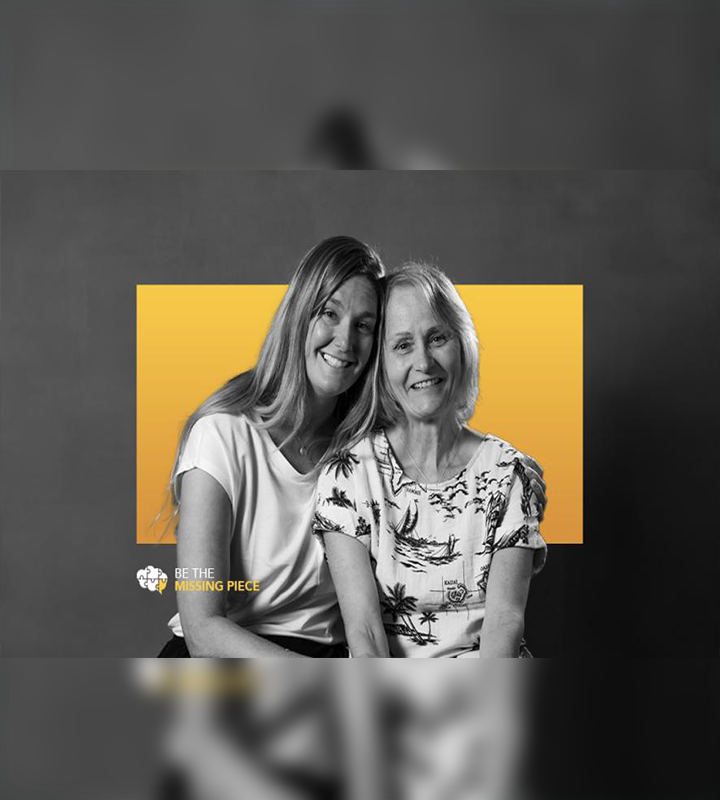
Peterborough, ON (January 18, 2024) - The Alzheimer Society of Peterborough, Kawartha Lakes, Northumberland and Haliburton has launched an anti-stigma awareness campaign created by students in Fleming’s Graphic Design-Visual Communication (GDV) program.
Each year, fifth semester GDV students are tasked with creating a campaign for an organization from the non-profit sector. This task gives students some hands-on experience in building and executing a project with a real client.
In June the Alzheimer Society announced that it would be using the concepts and components created by one student group in a real-world campaign that would stretch across the Peterborough region.
“Be the Missing Piece” launched January 17, 2024, during Alzheimer’s Awareness Month. This campaign aims to reduce the stigma around dementia by drawing attention to the language we use without thinking, which can be rude, dismissive, and hurtful.
You can find more about the campaign here.
About Fleming College
Fleming College respectfully acknowledges that we are situated on Michi Saagiig Anishinaabeg lands and territory. Located in the heart of Central Ontario, Fleming College has campus locations in Peterborough, Lindsay, Cobourg and Haliburton. Named for famous Canadian inventor and engineer Sir Sandford Fleming, the college features more than 100 full-time programs in Arts and Heritage, Business, Environmental and Natural Resource Sciences, General Arts and Sciences, Health and Wellness, Justice and Community Development, Skilled Trades and Technology, and Continuing Education. Fleming College has more than 6,800 full-time and 10,000 part-time students, and 80,000 alumni.
For media enquiries, please contact:
Sarah Deeth
Communications Officer
sarah.deeth@flemingcollege.ca
705-749-5530 ext. 1161
Web: flemingcollege.ca
Facebook: facebook.com/flemingcollege
Twitter: @FlemingCollege on Twitter
Instagram: @flemingcollege on Instagram