Cultural Heritage Conservation and Management
As a Cultural Heritage Conservation and Management specialist, you will learn the techniques and science behind saving historic objects of a wide range of material types – preserving them for future generations to learn from and enjoy.
Program Information
Start Date
September 07, 2027
Domestic Availability
Accepting Applications
International Availability
Coming Soon
CIP Code
30.1202
Program Code
CHM
Delivery
In Person, Placement
Credential
Ontario College Graduate Certificate
Academic School
Location
Program Contact
Domestic Tuition
per semester*
International Tuition
per semester*
*Domestic tuition amounts shown are from the 2026-2027 academic year and are subject to change.
*International tuition amounts shown are from the 2026-2027 academic year and are subject to change.
Apply Now
Canadian StudentsView Curriculum
The fundamental role of the conservation professional is to preserve and conserve, as appropriate, cultural property for present and future generations. To retain these records of the past takes experience in both preventative and treatment conservation, as well as the science of materials. These skills allow us to keep alive pieces of history so we can learn from the experiences and events of those who have gone before us. Imagine how much history is lost to us when an ancient artifact is destroyed whether through unintended deterioration or intentional damage.
This two-year Ontario College graduate certificate is an intensive, fast-paced learning experience that you will undertake in four consecutive semesters. You'll start your classes in September and spend your first three semesters, during the fall, winter and summer, at the college. Following your introduction to the field of conservation, you will gain valuable, applied and skills-based experience in the care and handling of most common museum materials, including ceramics, glass, stone, metals, wooden objects, leather and proteinaceous materials, textiles, works of art on paper, books, archival materials, photographs and modern materials. Updated curriculum reflects a focus on hands-on skills, experienced based learning, practical applications, beyond best practices and professional standards rooted in ethical applications. Once you've learned the theory and practical skills, you'll treat museum artifacts from local, regional, and national sites. Complementary courses, workshops, assignments, and community-based projects will offer off campus opportunities to practice conservation methods. A full-time, typically unpaid, curriculum-based internship in your final semester (September to December) provides an invaluable learning and work experience.
The program has highly skilled and friendly instructors, who gave me a thorough and comprehensive education in the care and conservation of key material types. I had great opportunities to network and work on projects in the field , and that proved to be a great asset once I was looking for employment.
Rachel Nordstrom, Program Graduate - Photographic Collection Manager, Department of Special Collections, University of St. Andrews
Sometimes choosing the right College program can be a daunting task, you want to ensure that you are provided with knowledge and know-how, but also something special that makes you stand out. Choosing the Conservation Program at Fleming College did just that and it was one of the best decisions I ever made!
Tracy Satin, Program Graduate -Director/Curator, Greater Vernon Museum and Archives
The program contributed to getting me here by providing me with the training, skill set and experience (internship) necessary to work in this position. It wasn’t a straight path but an interesting one, and one that I hope continues ahead
Anne Macdonnell, Program Graduate - Paper and Textiles Conservator, Canadian War Museum
As a museum manager, I have found interns and graduates from the Fleming Museum Management and Curatorship and Cultural Heritage Conservation and Management programs to be motivated, skilled and committed to a career in the heritage sector. Following a recent nationwide search for an Assistant Curator/Collections Coordinator, our top two choices out of more than 250 applicants were both Fleming grads.
John Summers, M.M.St., Employer - Manager Heritage Resource Management Planning and Economic Development Tourism and Culture, City of Hamilton
Fleming College's Cultural Heritage Conservation Management program is the only college-level postgraduate training in cultural heritage conservation in Canada. It is widely recognized as providing the optimum synthesis of art and science; graduates are appreciated for their professional ethics and standards, knowledge of sustainable preservation practices, and hands-on experience in the field.
There are many opportunities to get practical experience both at the college and off-campus during your first three semesters. Then, in your fourth semester, you will take on a challenging, full-time, curriculum-based internship at an approved site. Students should be prepared to relocate for the internship, to pay full tuition fees, and be self-supporting during this semester. The internship is usually an unpaid study experience. You will negotiate your own internship with faculty assistance and some students have participated in internships abroad. Students are responsible for negotiating additional paperwork and funding requirements for international internships including visas, travel and insurance. Every reasonable attempt will be made to fit students to appropriate sites. Students in this program have participated in internships at the following sites and many others:
- Parks Canada - Conservation Laboratories
- Waterloo Regional Museum
- Peterborough Museum & Archives
- Provincial Archives of Alberta
- Royal British Columbia Museum
- Royal Alberta Museum
- British Museum
All course work must be successfully completed in order to be eligible for the internship. Satisfactory completion of the internship is a prerequisite for graduation.
In this program you require:
- Respect for tangible and intangible heritage
- A love of history, art, heritage and culture
- Good colour perception and visual acuity
- Outstanding manual dexterity
- Flexibility and organizational skills
- The ability to prioritize tasks and meet multiple demands under pressure
- Cultural sensitivity/awareness
- Proven time management, planning and teamwork skills
- Excellent communication and writing skills
- Experience with digital photography
- An strong interest in the science of art and objects
- A sense of humour
Experience or certification in the following are assets in the field:
- Digital photography
- Photoshop, Adobe Suite
- Ladder Training (required), Fall Arrest Training, or Working at Heights
- French language skills
- Fire Prevention Training
- Firearms Possession and Acquisition Licence (P.A.L.) (to work in military museums and many community museums)
- Experience working with databases
- Smart Serve Food Handling
- Other languages
- Valid driver's licence
- Criminal Reference Check Vulnerable Sector
- AODA Training
Expect to find work in heritage, historical, or cultural organizations and centres, such as archives, museums, historic sites, cultural/heritage institutions, interpretation centres and conservation labs. The employment rate of graduates is very impressive, especially if you are willing to move for work, and take the initiative in developing a network of contacts in the field. Job titles include:
- conservation assistant
- museum assistant
- curatorial assistant
- conservator
- collections care co-ordinator
- museum registrar
- heritage interpreter
- preservation officer
- preparator
Additional fees may be required for books, supplies, field trips or specialized workshops. Students are also required to purchase some conservation specific tools, brushes, lab materials and appropriate health and safety equipment. Be prepared to spend up to $1,500 for these. A laptop capable of running up-to-date Adobe Creative Suite software is necessary (software will be provided). The program will provide students with a membership in at least one professional organization, but students should consider joining others that match their interests and specializations.
If you have a complex medical history, we strongly advise you to discuss your concerns with the program co-ordinator, and to consult with your doctor. You must update Tetanus and all immunizations prior to the start of classes. In addition, students are required to pay certification fees and present current certification for Standard First Aid, CPR (C Level), WHMIS (G.H.S.) and Ladder training and a current Criminal Reference Check Vulnerable Sector Screening. Please provide proof of all documentation at the start of classes in the fall (do not send your documentation ahead of time). Links to mandatory free AODA training will be provided to those who are accepted into the program.
- Adhere to recognized safety practices and professional, legal and ethical standards within the conservation profession.
- Assess, manage and control a museum environment to provide sustainable and optimal care for collections.
- Monitor, protect and maintain artifacts in storage, on display and in transit.
- Assess and complete conservation treatments on a variety of materials and media found in collections using relevant knowledge of physical sciences.
- Collect, research, document, interpret and preserve tangible and intangible heritage using current data collection methods and best practices according to industry standards.
- Provide a rationale and detailed plan for the management and preservation of movable and immovable cultural property (collections and sites).
- Plan, cost, fabricate and install exhibits, display mounts and storage mounts to meet specific needs within a given budget and time frame.
- Apply principles of business and management in non-profit and for-profit heritage conservation sectors.
- Plan and implement sustainable and integrated approaches to risk assessment and preventive conservation for cultural property.
- Create reproductions using a variety of moulding, casting and finishing techniques.
- Use current and relevant terminology to communicate effectively with individuals, families and communities and their associated culture and material history.
- Prepare a portfolio that reflects professional and personal growth, achievements, job readiness, ongoing development and learning.
- Advocate for cultural assets and resources within the confines of economic restraints and other factors affecting the heritage conservation industry.
Students applying to Cultural Heritage Conservation and Management must meet the following requirements:
- Undergraduate degree, Ontario College diploma or Ontario College Advanced diploma or equivalent, and
- Grade 12 (C) Chemistry*
Watch our Webinar Wednesday Recording
In The News: Cultural Heritage Conservation and Management
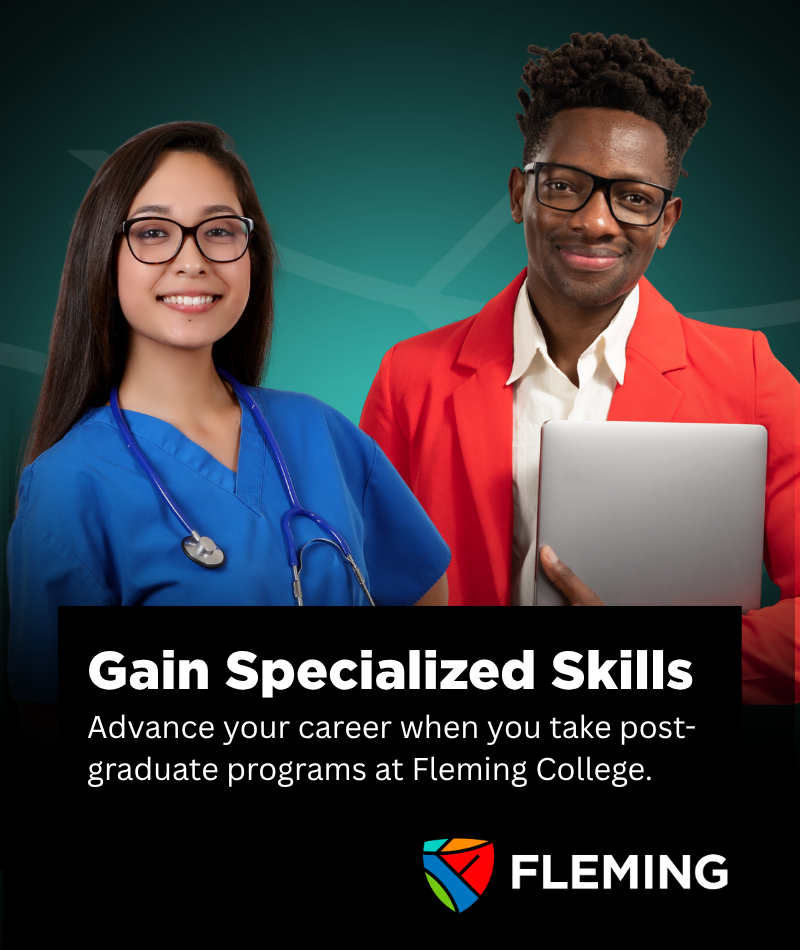
You worked hard to earn your college diploma or university degree. That's an achievement worth celebrating; it's the foundation of your career and a remarkable milestone.
As industries and workplaces evolve, many professionals are choosing to add specialized skills that complement their existing education and experience. Whether you're preparing for a specialized role, looking to advance in your field, or exploring a new career path, a Fleming post-graduate program can help you take your skill set even further.
Designed for graduates and working professionals, these programs combine practical, career-focused learning with industry expertise to help you develop the skills employers value today.
Why choose a post-graduate program?
Your diploma or degree has prepared you for your career. An Ontario College Graduate Certificate program builds on that foundation by helping you develop specialized knowledge in a focused area of study.
Leveraging your existing education, you'll deepen your expertise, expand your skills, and gain practical experience that can help you grow professionally. Most Fleming post-graduate programs can be completed in as little as two to four semesters, making them an efficient way to continue your education while preparing for new opportunities.
Whether you're a recent graduate or an experienced professional, a post-graduate program can help you:
- Develop specialized, industry-relevant skills
- Advance within your current profession
- Explore a new career direction
- Strengthen your resume with practical experience
- Build valuable industry connections
Learn from industry experts
At Fleming, learning goes beyond the classroom.
Programs are developed in collaboration with industry professionals and employers, ensuring the curriculum reflects current workplace needs. Depending on your program, you'll gain hands-on experience through applied projects, simulations, field experiences, or placements.
You'll graduate with specialized knowledge and practical experience you can confidently carry into your career.
Specialize in high-demand fields
One of the greatest benefits of earning an Ontario College Graduate Certificate is the opportunity to become an expert in a specialized area. Fleming offers a range of post-graduate programs to help you get there:
- Business
- Health Care
- Arts
- Environmental and Natural Resources
- Community Services
Flexible learning for every stage of your career
Not every professional goal requires a full graduate certificate, and sometimes your schedule or circumstances call for a more flexible option.
That's where Fleming's Continuing Education offering comes in. Whether you're looking to update your skills, earn a certificate, or explore a new area of expertise, you'll find flexible professional development options designed to fit your life and career goals.
With courses, certificates, and specialized programs offered online, in hybrid formats, and part-time, you can continue learning while balancing work, family, and other commitments. It's a convenient way to stay current in your field, expand your knowledge, or prepare for your next career move, without putting your life on hold.
Take the Next Step in Your Career
You've already built a strong foundation with your diploma or degree. Now it's time to build on it. Whether you're looking to specialize, advance in your current field, or explore new opportunities, Fleming's Ontario College Graduate Certificate programs and Continuing Education pathways can help you get there.
Explore Fleming's post-graduate programs and Continuing Education opportunities to find the pathway that fits your goals—and take the next step toward the career you want.
Talk to a Student Recruitment Advisor today to learn more:
AskUs@flemingcollege.ca
*Part of our Continuing Education program offerings.

We recently hosted a Webinar Wednesday session exploring two of our unique programs: Museum Management and Curatorship (MMC) and Cultural Heritage Conservation and Management (CHM). If you couldn’t join us live don’t worry, we’ve rounded up the key highlights below, and you can watch the full recording at your convenience.
These programs are known for their hands-on, immersive learning experiences and strong connections to the museum and heritage sector. During the session, prospective students heard directly from Dr. Amy Barron, Program Coordinator, and recruitment representative Nick Draker-Fortis, who walked through what each program looks like in practice. From exhibit development and collections work to conservation labs and internships, the webinar provided a detailed look at how students gain real-world experience and build the skills needed for careers in museums, galleries, and heritage institutions.
WHY CONSERVATION AND MUSEUM STUDIES AT FLEMING?
Fleming’s post-graduate Heritage Programs offer truly hands-on approaches to learning, giving students the opportunity to step beyond the classroom and into real museum environments. From day one, students gain practical experience working with collections, developing exhibits, and collaborating with community partners like the Peterborough Museum and Archives, which acts as home base for one of our programs while the dedicated conservation lab is home to the other. Small class sizes and close faculty mentorship create a supportive, collaborative environment where students build both technical skills and professional confidence. By the time they graduate, students leave with a strong portfolio of real-world projects and the experience needed to thrive in a wide range of museums and cultural settings.
THREE KEY TAKEAWAYS
1. Two distinct programs, two different career paths
The webinar highlighted how MMC and CHM differ not just in theory, but in day-to-day learning. MMC students build a wide range of museum skills, including creating exhibits from scratch. For example, students start with a small one-artifact exhibit in semester one, then collaborate on a full-scale exhibition at the Peterborough Museum and Archives in semester two. In contrast, CHM students focus on conservation science, working directly with materials like metals, textiles, and paper. By later semesters, they are treating real artifacts on loan from museums, applying chemistry-based techniques to preserve them.
2. Real-world experience through community partnerships and unique projects
Students don’t just learn in the classroom, they actively work with local and national partners. The webinar shared examples like MMC students collaborating with the Peterborough Museum and Archives and Lang Pioneer Village to develop exhibits, while CHM students have worked on projects such as cleaning gravestones at a local pioneer cemetery or visiting the Canadian Conservation Institute in Ottawa to explore federal conservation labs. These experiences give students exposure to a wide range of heritage settings and hands-on problem solving.
3. Diverse and impactful internship opportunities across Canada and beyond
Internships are a major highlight of both programs, with highly personalized placement support. Examples shared in the webinar included students working at the Hockey Hall of Fame, the Canadian War Museum, the Royal Botanical Gardens (preserving historic herbariums from the 1700s), and Parks Canada labs. Others gained experience in archives, art galleries, and even zoos, sometimes leading projects like designing their own exhibits. These placements not only build confidence but also often lead to job opportunities after graduation.
CHECK OUT THE FULL WEBINAR:
HAVE QUESTIONS OR WANT TO LEARN MORE?
If this session sparked your interest or you’re considering a future in the arts, we’d love to connect with you. Our Student Recruitment. team and program representatives are here to answer questions, help you explore admission pathways, or guide you toward the right next step. Be sure to check out our upcoming Webinar Wednesday sessions online. We’re hosting new topics in the months ahead and it’s a great way to learn more about programs that excite you.
CAN’T?MAKE A LIVE WEBINAR WEDNESDAY EVENT??
No problem! We’ll save video recordings on Fleming’s official YouTube channel. And?don’t?worry, Program Coordinators are always available to answer your questions!???
For more information about Webinar Wednesdays, please contact Student Recruitment.?
Looking to gain an edge in your field or pivot to a new one entirely? Fleming College’s post-graduate programs are designed to support you in the next chapter of your career. Whether you're building on your undergraduate degree, returning to school to refine your skills, or applying a credential to the knowledge and experience you've gained in the field, our post-grad certificates and diplomas blend real-world experience with practical, career-focused training.
What is a post-graduate program?
A post-graduate program is designed for students who already hold a college diploma or university degree, and/or have relevant work experience. These programs, which range from two to four semesters, are perfect for those looking to sharpen their skills, specialize in a niche field, or transition into a new career.
Why Choose Fleming?
Fleming College's post-graduate programs are shaped by the needs of the job market and powered by strong community and industry partnerships. Many of our programs include internships, co-ops, or field placements to give you valuable, hands-on experience before you graduate.
You'll also benefit from:
- Access to expert faculty with industry experience;
- Career support, resume help, and job search guidance; and
- A welcoming, supportive learning environment
Explore Fleming’s Post-Graduate Programs
School of Environmental and Natural Resource Sciences
- What you’ll learn about: In addition to food production, you will learn about aquaculture activities, including the production of fish for conservation and production for ornamental species. You’ll also gain valuable experience with zebrafish (a key model species in ecotoxicology and biomedical research).
- Career opportunities: Food Production, Conservation, Aquaponics, and Pond/Garden Markets.
- Duration: 2 semesters
Environmental Land Management – Canadian Context
- What you’ll learn about: Discover how to turn your passion for creating more liveable, sustainable communities into a career in Canada’s environmental sector.
- Career opportunities: Municipal Land Use Planning, Urban Planning, Parks and Recreation Planning, Transit Planning, Environmental Planning, Management Consultancy.
- Duration: 4 semesters
School of Business
- What you’ll learn about: Learn how to design and create software by embedding AI into applications that meet industry needs. Modern software design and AI frameworks, machine learning, and big data fundamentals are the basis of this program.
- Career opportunities: AI Engineer, Programmer, Business Intelligence Developer, Data Analyst, Research Scientist/Engineer, Software Engineer/Architect, Machine Learning Engineer, and more.
- Duration: 2 semesters
- What you’ll learn about: You will learn about various digital tools and technologies, how to create project management frameworks, digital strategies and tactics, and more.
- Career opportunities: Digital Marketing and Communications, Marketing Project Management, Advertising Accounts Management, and Media Coordination.
- Duration: 2 semesters
Haliburton School of Art + Design
Cultural Heritage Conservation and Management
- What you’ll learn: This program prepares you to care for and conserve historical artifacts, with opportunities to work directly with organizations like the Peterborough Museum and Archives.
- Career opportunities: Conservation Assistant, Museum Assistant, Curatorial Assistant, Conservator, Collections Care Coordinator, Museum Registrar, and more.
- Duration: 4 semesters
Museum Management and Curatorship
- What you’ll learn: Develop curatorial and exhibit planning skills while learning the ins and outs of non-profit administration and museum operations. Intern at partner institutions and gain real-world museum experience.
- Career opportunities: Collections Manager, Curator, Digital Content and Marketing Coordinator, Education Officer, Exhibit Designer, Fundraiser, and more.
- Duration: 3 semesters
School of Health and Community Services
Health Care Management – Canadian Context
- What you’ll learn: Learn about health law, policy, human resources, and financial management—preparing you for administrative and coordination roles in hospitals, clinics, and NGOs.
- Career opportunities: Graduates may work in settings such as clinics, hospitals, long-term care facilities, private facilities and home care.
- Duration: 4 semesters
Perioperative Nursing (RN and RPN)
- What you’ll learn: Training covers everything from sterilization and surgical instrumentation to interprofessional communication in high-pressure environments.
- Duration: 1 semester
Community Collaboration in Addictions and Mental Health
- What you’ll learn: You'll explore how professionals collaborate to deliver impactful public services, gaining hands-on experience with inclusive, client-centred strategies that support individuals, families, and communities.
- Career opportunities: Community mental health worker, outreach coordinator, crisis intervention specialist, and more.
- Duration: 2 semesters
How to Apply to a Post-Graduate Program at Fleming College
To enrol in a post-graduate program at Fleming, you’ll need to have a college diploma or university degree from a recognized institution (or, in some cases, a minimum amount of relevant work experience). Some programs may have additional requirements (such as a healthcare license or specific academic background), so be sure to review the admission criteria for your program of interest.
Most applications require:
- Official transcripts
- Resume
- Statement of interest
- (Optional) Letters of recommendation
Application deadlines vary by program. We recommend applying early to secure your spot.
Whether you’re diving deeper into your field or charting a new path, a post-graduate program at Fleming College can help you get there with confidence and purpose.
Get the inside scoop on campus life, student experiences, and expert tips.
From hidden study spots to career advice, our blog is your go-to source for insights, inspiration, and everything in between. Have an inspiring journey, a unique campus experience, or a success story to share? Submit your blog idea to the Fleming Connect team for your chance to showcase your story to the entire Fleming community.