Biotechnology - Advanced
Formerly named: Biotechnology Technologist - Forensics
The Biotechnology - Advanced program trains students for lab careers in health, research, microbiology, DNA, environment, and QA/QC, with a semester-long placement to build practical and transferable skills.
Program Information
Start Date
September 07, 2027
Domestic Availability
Accepting Applications
International Availability
Coming Soon
CIP Code
41.0101
Program Code
BTF
Delivery
Hybrid, Placement
Credential
Ontario College Advanced Diploma
Academic School
Location
Program Contact
Domestic Tuition
per semester*
International Tuition
per semester*
*Domestic tuition amounts shown are from the 2026-2027 academic year and are subject to change.
*International tuition amounts shown are from the 2026-2027 academic year and are subject to change.
Apply Now
Canadian StudentsView Curriculum
September 07, 2027
Domestic Availability
Accepting Applications
International Availability
Coming Soon
CIP Code
41.0101
Program Code
BTF
Delivery
Hybrid, Placement
Credential
Ontario College Advanced Diploma
Academic School
Location
Program Contact
Domestic Tuition
per semester*
International Tuition
per semester*
*Domestic tuition amounts shown are from the 2026-2027 academic year and are subject to change.
*International tuition amounts shown are from the 2026-2027 academic year and are subject to change.
Apply Now
Canadian StudentsView Curriculum
Biotechnologists are the behind-the-scenes scientists who develop and improve products, technologies and processes across many industries, using biology, chemistry and genetics
The Biotechnology - Advanced program focuses on:
- Extensive lab-based skills: Close to 500 hours of hands-on training in your first four semesters.
- Unique combination of courses: Recognized by employers as one of the broadest-based lab skills programs, which puts our graduates in demand across a variety of fields.
- More than just technical skills: Our students are trained to become critical thinkers with problem-solving abilities, strong interpersonal, teamwork and communication skills - attributes that serve them well throughout their career.
- Comprehensive placement: With up to 600 hours of work experience during your final semester placement you will be fully prepared for your career.
Fast-track option Graduates with a degree can apply to the Biotechnology - Advanced Fast Track program and enter in Semester 3.
A 600-hour placement will immerse students in the work culture of a lab environment, give them the opportunity to seek experience in an area of specialization, and promote networking and awareness of the industry and job potential. Students will work with their faculty in selecting a placement that will be right for them.
Graduates from the Biotechnology-Advanced program earn an Ontario College Advanced Diploma.
Non-Academic Requirements
Any non-academic requirements will be communicated to students during Semester 3.
Missing Admission Requirments?
If you are 19 years of age or older before classes start, and you do not possess an OSSD, you can write the Canadian Adult Achievement Test to assess your eligibility for admission. Additional testing or academic upgrading may be necessary to meet specific course requirements for this program. All applicants will be required to achieve course credit in the mandatory sciences, through Secondary School, Academic Upgrading or College preparatory programs.
If you don't possess the required science courses for admission to this program, or if you want to enhance your likelihood for entry, consider the one-year Pre-Health Sciences Pathway to Certificates and Diplomas. Fleming College has reserved space in the Biotechnology - Advanced program for students who successfully complete one year of study in this program.
In addition to tuition fees, additional costs for this program include:
| Semester 1 | Semester 2 | Semester 3 | Semester 4 | Semester 5 | |
|---|---|---|---|---|---|
| Textbook Cost | $1,414.00 | $996.00 | |||
| Field Placement expenses | Travel and or parking costs - varies depending on placement location | ||||
Career Opportunities
Graduates of this program will be well-equipped to pursue diverse roles across the biotechnology industry, whether in private companies, public institutions, research facilities, or specialized labs. Their skills will open doors to a wide range of career paths in this dynamic and evolving field, including:
- Research technician/technologist (in areas such as cancer, disease, environmental, etc.)
- Microbiology testing (food, water, pharmaceuticals, cosmetics)
- Quality assurance/quality control (food, pharmaceutical, manufacturing)
- Forensic labs
- Hospital and clinical settings
- Pharmaceutical companies
- Government agencies such as the Canadian Food Inspection Agency, Canadian, Centre for Forensic Science, and Public Health
- Municipal wastewater and drinking water treatment facilities
- Pathogen and toxicology testing (plant and animals)
- Wildlife management and restoration (environmental DNA)
- Cannabis labs
- COVID19 testing and medical related fields (may require additional qualifications)
- Chemical analysis and instrumentation
- Nuclear power generation
- Environmental lab analysis (water, geological and biological material)
Education Pathways
Graduates of this program can continue their studies at a university level with transfer credits, as per our Transfer Agreements at the bottom of this page. The practical skills gained in the academic labs and during your placement will give you distinct advantages in further studies and your career.
University graduates may be eligible to apply for entry into Semester 3 through the Biotechnology - Advanced Fast Track (BTP) program:
- Graduates from Trent University with a Bachelor of Science in Biology, Biochemistry & Molecular Biology, Forensic Biology or Forensic Science with a minimum degree average of 75%*.
- Graduates from Ontario Tech University with a Bachelor of Science in Biological Science or Forensic Science with a minimum degree average of 75%*.
- All other graduates with a Bachelor of Science degree will be assessed on a case-by case basis.
*Applicants with a degree average of 70-74% will be considered on a case-by-case basis.
- Monitor and perform laboratory duties in compliance with relevant legislation, regulations, biotechnology standards, and guidelines.
- Evaluate and implement quality control and quality assurance practices to maintain compliance with relevant standards and requirements.
- Promote and implement sustainable practices in biotechnology operations to minimize environmental impact and improve resource efficiency.
- Analyze biotechnological problems to propose solutions to complex challenges during the execution of lab responsibilities.
- Conduct quantitative and qualitative laboratory tests to support research findings in biotechnology projects.
- Coordinate and implement standard cell culture procedures under aseptic conditions to validate experimental results and maintain laboratory safety.
- Coordinate and perform molecular biology procedures to support biotechnological applications.
- Collect, manage and analyze scientific data to support biological scientists and researchers in advancing research initiatives and outcomes.
- Analyze and communicate scientific data to meet industry standards and advance research outcomes.
- Incorporate strategies for ongoing personal and professional development to show improvements in performance and stay current in biotechnology.
- Align business goals to optimize resources and drive growth in biotechnology enterprises.
Students applying to Biotechnology - Advanced must meet the following requirements:
- OSSD including Gr 12 C English, Gr 12 C Math and any two Gr 11 or 12 C Sciences
PC / Windows
- Operating System:Windows 10
- Processor:Core i5 - 1.6Ghz minimum
- Memory:8GB minimum
- Hard Disk:160GB minimum
Internet Connection: 2.5 Mbps Download and 3.0 Mbps Upload (minimum)
Transfer Agreements
You may be able to use credits obtained at Fleming College to continue your postsecondary education in pursuit of a degree. The articulation and credit transfer agreements with our partner institutions are summarized here.
Bachelor of Professional Arts in Human Services
Requirement
- Completion of the program.
Transfer Credit
- 30 out of a 120-credit degree.
- Refer to the articulation statement for further details.
To apply please see the Apply Alberta website.
For more information
Visit the Athabasca University website for further articulation and program information.
See the official articulation agreement.
Bachelor of Science in Applied Mathematics
Requirement
- Completion of the program.
Transfer Credit
- 30 out of a 120-credit degree.
- Refer to the articulation statement for further details.
To apply please see the Apply Alberta website.
For more information
Visit the Athabasca University website for further articulation and program information.
See the official articulation agreement.
Bachelor of Science in Computing and Information Systems
Requirement
- Completion of the program.
Transfer Credit
- 30 out of a 120-credit degree.
- Refer to the articulation statement for further details.
To apply please see the Apply Alberta website.
For more information
Visit the Athabasca University website for further articulation and program information.
See the official articulation agreement.
Bachelor of Science in Applied Life Science
Requirement
- Minimum 75% cumulative program average.
Transfer Credit
- 10 out of a 20-credit degree.
- Refer to ONTransfer.ca for further details.
To apply please see the Ontario Universities' Application Centre (OUAC) website.
For more information
Visit the Lakehead University website for further articulation and program information.
Visit the ONTransfer.ca website for agreement information.
Bachelor of Science in Environmental Biology and Technology
Requirement
- Minimum 72% cumulative program average.
Transfer Credit
- 69 out of a 120-credit degree.
- Refer to ONTransfer.ca for further details.
To apply please see the Ontario Universities' Application Centre (OUAC) website.
For more information
Visit the Nipissing University website for further articulation and program information.
Visit the ONTransfer.ca website for agreement information.
Bachelor of Allied Health Science
Requirement
- Minimum mid-70% cumulative program average.
- Completion of the Ontario Tech Allied Health Sciences Bridge.
Transfer Credit
- 57 out of a 120-credit degree.
- Refer to ONTransfer.ca for further details.
To apply please see the Ontario Universities' Application Centre (OUAC) website.
For more information
Visit the Ontario Tech University website for further articulation and program information.
Bachelor of Arts - General
Requirement
- Minimum mid-70% cumulative program average.
Transfer Credit
- 60 out of a 120-credit degree.
- Refer to OntarioTech's website for further details.
To apply please see the Ontario Universities' Application Centre (OUAC) website.
For more information
Visit the Ontario Tech University website for further articulation and program information.
Bachelor of Arts in Educational Psychology
Requirement
- Minimum mid-70% cumulative program average.
Transfer Credit
- 60 out of a 120-credit degree.
- Refer to OntarioTech's website for further details.
To apply please see the Ontario Universities' Application Centre (OUAC) website.
For more information
Visit the Ontario Tech University website for further articulation and program information.
Bachelor of Arts in Educational Studies and Digital Technology
Requirement
- Minimum mid-70% cumulative program average.
Transfer Credit
- 60 out of a 120-credit degree.
- Refer to ONTransfer.ca for further details.
To apply please see the Ontario Universities' Application Centre (OUAC) website.
For more information
Visit the Ontario Tech University website for further articulation and program information.
Bachelor of Arts in Psychology
Requirement
- Minimum mid-70% cumulative program average.
Transfer Credit
- 60 out of a 120-credit degree.
- Refer to Ontario Tech's website for further details.
To apply please see the Ontario Universities' Application Centre (OUAC) website.
For more information
Visit the Ontario Tech University website for further articulation and program information.
Bachelor of Arts in Sociology, Technology and Innovation
Requirement
- Minimum mid-70% cumulative program average.
Transfer Credit
- 60 out of a 120-credit degree.
- Refer to OntarioTech's website for further details.
To apply please see the Ontario Universities' Application Centre (OUAC) website.
For more information
Visit the Ontario Tech University website for further articulation and program information.
Bachelor of Commerce
Requirement
- Minimum mid-70% cumulative program average.
- Completion of the Ontario Tech Commerce Bridge.
Transfer Credit
- 45 out of a 120-credit degree.
- Refer to ONTransfer.ca for further details.
To apply please see the Ontario Universities' Application Centre (OUAC) website.
For more information
Visit the Ontario Tech University website for further articulation and program information.
Bachelor of Health Science in Medical Laboratory Science
Requirement
- Minimum 77% cumulative program average.
- Present a comprehensive human anatomy and physiology course at the college or university level.
- Completion of the Ontario Tech Medical Laboratory Bridge.
Transfer Credit
- 39 out of a 120-credit degree.
- Refer to ONTransfer.ca for further details.
To apply please see the Ontario Universities' Application Centre (OUAC) website.
For more information
Visit the Ontario Tech University website for further articulation and program information.
Bachelor of Science in Biological Science
Requirement
- Minimum mid-70% cumulative program average.
Transfer Credit
- 60 out of a 120-credit degree.
- Refer to ONTransfer.ca for further details.
To apply please see the Ontario Universities' Application Centre (OUAC) website.
For more information
Visit the Ontario Tech University website for further articulation and program information.
Visit the ONTransfer.ca website for agreement information.
Bachelor of Interdisciplinary Studies
Requirement
- Minimum 65% cumulative program average.
Transfer Credit
- Entry into 5th semester standing in an 8-semester program.
- Refer to Seneca College's website for further details.
To apply please see the Ontario Universities' Application Centre (OUAC) website.
For more information
Visit the Seneca Polytechnic website for further articulation and program information.
Visit the ONTransfer.ca website for agreement information.
See the official articulation agreement.
Bachelor of Science (General) in Cosmetic Science
Requirement
- Minimum 65% cumulative program average.
Transfer Credit
- 15 out of a 30-course degree.
- Refer to ONTransfer.ca for further details.
To apply please see the Ontario Colleges website.
For more information
Visit the Seneca Polytechnic website for further articulation and program information.
Visit the ONTransfer.ca website for agreement information.
Bachelor of Science – Biotechnology
Requirement
- Minimum 70% cumulative program average.
Transfer Credit
- 23 out of a 42-course degree.
- Refer to ONTransfer.ca for further details.
To apply please see the Ontario Colleges website.
For more information
Visit the Seneca Polytechnic website for further articulation and program information.
Visit the ONTransfer.ca website for agreement information.
See the official articulation agreement.
Bachelor of Arts
Requirement
- Minimum 75% cumulative program average.
Transfer Credit
- 8 out of a 20-credit degree.
- Refer to ONTransfer.ca for further details.
To apply please see the Ontario Universities' Application Centre (OUAC) website.
For more information
Visit the Trent University website for further articulation and program information.
Visit the ONTransfer.ca website for agreement information.
See the official articulation agreement.
Bachelor of Science
Requirement
- Minimum 75% cumulative program average.
Transfer Credit
- 8 out of a 20-credit degree.
- Refer to ONTransfer.ca for further details.
To apply please see the Ontario Universities' Application Centre (OUAC) website.
For more information
Visit the Trent University website for further articulation and program information.
Visit the ONTransfer.ca website for agreement information.
See the official articulation agreement.
Bachelor of Science in Biology
Requirement
- Minimum 75% cumulative program average.
Transfer Credit
- 8 out of a 20-credit degree.
- Refer to ONTransfer.ca for further details.
To apply please see the Ontario Universities' Application Centre (OUAC) website.
For more information
Visit the Trent University website for further articulation and program information.
Visit the ONTransfer.ca website for agreement information.
See the official articulation agreement.
Bachelor of Science in Forensic Science
Requirement
- Minimum 75% cumulative program average.
Transfer Credit
- 8 out of a 20-credit degree.
- Refer to ONTransfer.ca for further details.
To apply please see the Ontario Universities' Application Centre (OUAC) website.
For more information
Visit the Trent University website for further articulation and program information.
Visit the ONTransfer.ca website for agreement information.
See the official articulation agreement.
Bachelor of Science in Nursing
Requirement
- Minimum 75% cumulative program average.
- Within the program, a minimum 65% average in two Biology, Chemistry, and Math courses.
- The application process is competitive, and the best-qualified candidates are offered admission. Meeting the terms of this articulation agreement does not guarantee admission to the program.
Transfer Credit
- 4 out of a 20-credit degree.
- Students transferring receive 7.0 transfer credits, with 4.0 applicable to program requirements.
- Refer to ONTransfer.ca for further details.
To apply please see the Ontario Universities' Application Centre (OUAC) website.
For more information
Visit the Trent University website for further articulation and program information.
Visit the ONTransfer.ca website for agreement information.
Bachelor of Science in Biochemistry
Requirement
- Minimum 75% cumulative program average.
- Completion of MHF4U (Grade 12 University Advanced Functions) or equivalent.
Transfer Credit
- 10 out of a 20-credit degree.
- Refer to ONTransfer.ca for further details.
To apply please see the Ontario Universities' Application Centre (OUAC) website.
For more information
Visit the University of Guelph website for further articulation and program information.
Visit the ONTransfer.ca website for agreement information.
Bachelor of Science in Biological Science
Requirement
- Minimum 75% cumulative program average.
- Completion of MHF4U (Grade 12 University Advanced Function) or equivalent.
Transfer Credit
- 10 out of a 20-credit degree.
- Refer to ONTransfer.ca for further details.
To apply please see the Ontario Universities' Application Centre (OUAC) website.
For more information
Visit the University of Guelph website for further articulation and program information.
Visit the ONTransfer.ca website for agreement information.
Bachelor of Science in Microbiology
Requirement
- Minimum 75% cumulative program average.
- Completion of MHF4U (Grade 12 University Advanced Function) or equivalent.
Transfer Credit
- 10 out of a 20-credit degree.
- Refer to ONTransfer.ca for further details.
To apply please see the Ontario Universities' Application Centre (OUAC) website.
For more information
Visit the University of Guelph website for further articulation and program information.
Visit the ONTransfer.ca website for agreement information.
Bachelor of Science in Molecular Biology & Genetics
Requirement
- Minimum 75% cumulative program average.
- Completion of MHF4U (Grade 12 University Advanced Function) or equivalent.
Transfer Credit
- 10 out of a 20-credit degree.
- Refer to ONTransfer.ca for further details.
To apply please see the Ontario Universities' Application Centre (OUAC) website.
For more information
Visit the University of Guelph website for further articulation and program information.
Visit the ONTransfer.ca website for agreement information.
Watch our Webinar Wednesday Recording
In The News: Biotechnology - Advanced

What’s it really like to complete an experiment in a college science lab? For a group of Grade 12 students who spent a day in Fleming College’s Biotechnology labs, the answer involved extracting their own DNA, learning advanced laboratory techniques, and experiencing first-hand what post-secondary science education can look like.
The Grade 12 Lab Day gave students the opportunity to step into a biotechnology work environment and spend the day exploring the exciting world of DNA, genotyping (analyzing DNA to identify genetic variations), and applied science. Designed for students with an interest in biology, chemistry, and biotechnology, the experience combined hands-on learning with exposure to potential careers.
A Hands-On Biotechnology Experience
During the Lab Day, students completed a full DNA extraction using their own cheek cells. With guidance from Biotechnology faculty and lab staff, students followed professional laboratory protocols while using real scientific equipment, materials, and techniques.
After extracting their DNA, students learned how scientists quantify and qualify DNA samples before moving into the next stage. For many students, this was their first opportunity to learn in a post-secondary lab setting, and it left a strong impression.
One student shared:
"I learned what it felt like to be in a college lab. Getting a glimpse into the feel of post-secondary was very cool for me.”
Other students reflected on the practical skills they developed throughout the workshop:
"I learned how different lab equipment worked, how to use the gels, and was able to practice my pipette skills/precision."
"Being in a lab environment helped me gain confidence in doing pipetting."
(Note: Pipetting is the process of measuring, transferring, or dispensing small volumes of liquid using a lab tool called a pipette.)
Through opportunities like this, Fleming helps students connect classroom science concepts to real-world applications and build their confidence while giving high school teachers a unique experiential learning opportunity for their classes.
Students Gain an Understanding of the Science Behind DNA
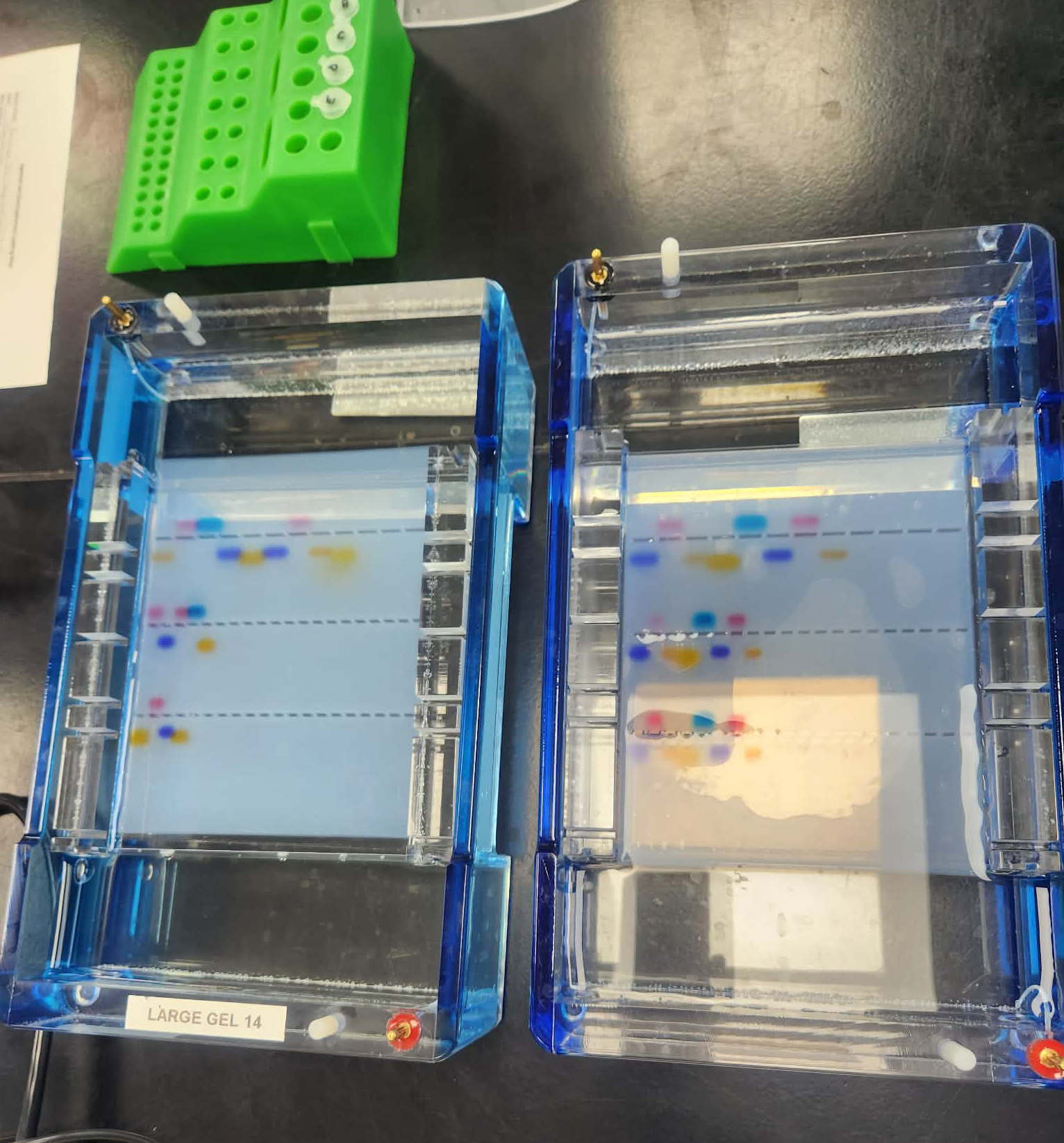
A major focus of the day at Fleming was introducing students to genotyping, DNA fingerprinting, and DNA analysis, important tools used across many areas of modern science and biotechnology.
Genotyping allows scientists to determine which alleles (genes) are present at a specific location, or locus, in DNA. Since each person inherits one allele from each parent, this process can help create a DNA fingerprint.
DNA fingerprinting plays an important role in many fields, including forensic science, medical research, environmental monitoring, and food safety testing. Students learned that DNA analysis is not limited to humans either. Animal and plant DNA are also studied for purposes such as species identification, wildlife conservation, and border inspection services.
For students considering careers in biotechnology?or?conservation biology, seeing these concepts applied in a real science lab helped demonstrate how broad and impactful the field can be.
A Glimpse into Science Studies at Fleming College
Beyond the science itself, the Grade 12 Lab Day was designed to help students experience what life can feel like in Fleming’s Biotechnology – Advanced program.
Throughout the day, students completed worksheets, practiced lab techniques, and learned how a college laboratory operates. The goal was not only to teach biotechnology concepts, but also to help students imagine themselves in a future post-secondary setting.
For parents and educators, experiences like this can be incredibly valuable. Spending time at Fleming College’s Sutherland Campus allows students to explore their interests early and start thinking about possible academic and career pathways.
Lab Days like this can help students discover what areas of science excite them most while also introducing them to the expectations and opportunities of post-secondary education.
Students Consider Careers in Biotechnology
The biotechnology industry continues to grow across sectors including healthcare, environmental science, food production, pharmaceuticals, and forensic science, making it an exciting field for students passionate about discovery and innovation.
Grade 12 Lab Day provided students with an opportunity to explore and learn about a wide range of exciting and evolving careers as graduates of the Biotechnology – Advanced program. Many of those opportunities are listed on Fleming’s??Biotechnology – Advanced? program page.
High schools interested in booking a Grade 11 or Grade 12 Lab Day experience, in the areas of Biology, Chemistry, or DNA, can contact Fleming College’s ?Biotechnology – Advanced Program Coordinator at btfcoordinator@flemingcollege.ca.??
Students interested in learning more about the?Biotechnology – Advanced?program?can reach out to our?Student Recruitment?team via?e-mail.?
Watch a replay of our Webinar Wednesday video for an in-depth look into the Biotechnology - Advanced program.
Biotechnology - Advanced
Last week, we hosted a Webinar Wednesday session shining a spotlight on our Biotechnology – Advanced program. If you couldn’t join us virtually, don’t worry. Below are the highlights from the session, along with the full recording below to watch at your convenience.
Fleming College’s Biotechnology program, within the School of Health and Community Services, is known for its intensive lab training, industry-focused curriculum, and strong emphasis on real world application. Prospective students joined Nick from Student Recruitment, Sol from Fleming’s International team, and Amanda Rochon, Program Coordinator for the program, to learn more about what to expect.
Why Biotechnology at Fleming?
The Biotechnology program at Fleming is designed to prepare students for real lab environments from day one. With a strong mix of foundational science, extensive hands-on lab training, and a dedicated field placement semester, students build the technical skills and professional confidence employers are looking for. Graduates leave with significant lab experience, industry exposure, and a flexible skill set that can lead to opportunities across biotech, research, quality control, analytical testing, and related science sectors.
For students who already hold a science-based diploma or degree, a Fast Track option is also available. Qualified applicants can enter directly into semester 3, completing the advanced lab focused semesters and the placement in a shorter timeframe. This pathway allows students to strengthen their hands on experience and add an industry placement to their academic background.
Three Key Takeaways
1. A fast, hands-on program with real lab time
The Biotechnology program is structured to build confidence step-by-step. In semesters 1 and 2, students focus on foundational courses such as biology, chemistry, math, physics, scientific communication, and introductory DNA applications. These early semesters are designed to strengthen core knowledge while introducing essential lab techniques and tools.
As students move into semesters 3 and 4, the program becomes more specialized and intensive. Courses expand into molecular biology, microbiology, biochemistry, pharmacology and toxicology, analytical chemistry, lab automation, and quality control and assurance. DNA courses run throughout the program, allowing students to continuously build and refine their skills. This layered structure ensures students feel prepared as they move into more advanced and applied lab work.
2. Students gain nearly 500 hours of hands-on lab training
A major highlight of the webinar was the emphasis on time spent in the lab. Over the first four semesters, students complete close to 500 hours of hands-on lab experience. Training begins with foundational skills such as pipetting, calculations, and safe lab practices, then progresses into complex applications like DNA extraction, quantification, profiling, microbiological analysis, and instrumentation.
Students work with industry relevant tools and techniques, including liquid handling automation, database systems, analytical instruments, and quality control procedures. By the final semester, students are completing advanced DNA projects and competency-based assessments that mirror real workplace expectations. This high volume of lab time helps graduates enter placement and employment with strong technical confidence.
3. A full semester placement with strong career flexibility
Semester 5 is entirely dedicated to a field placement of up to 600 hours. Students work in industry, research, healthcare, environmental, or quality control settings, gaining meaningful experience and professional connections. The placement process is student driven, allowing learners to explore opportunities based on their interests and geographic preferences, with faculty support throughout.
The program also includes professional practice preparation, such as resume development, interview practice, and workplace readiness training. Graduates pursue careers across a wide range of sectors including research institutes, diagnostic labs, fertility clinics, environmental testing facilities, and forensic settings. Some continue into university degree pathways or medical lab technology programs, while others secure employment directly through their placement experience.
CHECK OUT THE FULL WEBINAR:
HAVE QUESTIONS OR WANT TO LEARN MORE?
If this session sparked your interest or you are considering a future in biotechnology, we would love to connect with you. Our Student Recruitment team and program representatives are here to answer questions, help you explore admission pathways, or guide you toward the right next step. Be sure to check out our upcoming Webinar Wednesday sessions online. We’re hosting new topics in the months ahead and it’s a great way to learn more about programs that excite you.
CAN’T?MAKE A LIVE WEBINAR WEDNESDAY EVENT??
No problem! We’ll save video recordings on Fleming’s official YouTube channel. And?don’t?worry, Program Coordinators are always available to answer your questions!???
For more information about Webinar Wednesdays, please contact Student Recruitment.?
Meet Sarah Donald
Graduate Sarah Donald shares her experience in the program and getting hired full-time after completing her internship at the Ontario Institute for Cancer Research.
Meet Mehar
Mehar is a co-op from Fleming College and spent the summer working in the Diagnostic Development department at OICR.
Meet Rachel
Rachel is a co-op from Fleming College and spent the summer working in the Diagnostic Development department at OICR.
Meet Madison McIntyre
Madison Mcintyre shares her personal journey including the learning experiences and support she received in the program, culminating with getting to do her placement at the Arthritis Research Foundation.