Customs/Border Services Administration
Formerly named: Customs Border Services
The Customs/Border Services Administration program will prepare you for a career on the front line of global trade and law enforcement.
Program Information
Start Date
September 08, 2026
Domestic Availability
Accepting Applications
International Availability
Closed
CIP Code
52.0410
Program Code
CSA
Delivery
In Person
Credential
Ontario College Diploma
Academic School
Location
Program Contact
Domestic Tuition
per semester*
International Tuition
per semester*
Apply Now
Canadian StudentsView Curriculum
January 11, 2027
Domestic Availability
Accepting Applications
International Availability
Closed
CIP Code
52.0410
Program Code
CSA
Delivery
In Person
Credential
Ontario College Diploma
Academic School
Location
Program Contact
Domestic Tuition
per semester*
International Tuition
per semester*
Apply Now
Canadian StudentsView Curriculum
September 07, 2027
Domestic Availability
Coming Soon
International Availability
Coming Soon
CIP Code
52.0410
Program Code
CSA
Delivery
In Person
Credential
Ontario College Diploma
Academic School
Location
Program Contact
Domestic Tuition
per semester*
International Tuition
per semester*
*Domestic tuition amounts shown are from the 2026-2027 academic year and are subject to change.
*International tuition amounts shown are from the 2026-2027 academic year and are subject to change.
Apply Now
Canadian StudentsView Curriculum
January 10, 2028
Domestic Availability
Coming Soon
International Availability
Coming Soon
CIP Code
52.0410
Program Code
CSA
Delivery
In Person
Credential
Ontario College Diploma
Academic School
Location
Program Contact
Domestic Tuition
per semester*
International Tuition
per semester*
*Domestic tuition amounts shown are from the 2026-2027 academic year and are subject to change.
*International tuition amounts shown are from the 2026-2027 academic year and are subject to change.
Apply Now
Canadian StudentsView Curriculum
The scope of border operations continues to expand. Cross-border trade, which now exceeds over $1 billion a day, and the continuous flow of international travellers can offer you many challenging career opportunities in both the public and private sectors.
Experiential, hands-on learning with real life enforcement tools is an integral part of the program. You will also participate in a mandatory field placement, where you will gain valuable work experience that often results in an offer of employment if you meet the employer’s standards.
Throughout this program you can expect to:
- Learn the role and legislative jurisdiction of Customs, Immigration and other Government departments
- Apply enforcement techniques and procedures for the cross-border movement of people and goods
- Learn how to complete and scrutinize cross-border documentation relating to duties, taxes, transportation, and other government departments
- Apply customs legislation, regulations, and procedures
- Develop dispute resolution, critical thinking skills and communications that are in demand for both private and public sectors of customs/border services in Canada
Fleming Customs/Border Services Administration program has the most customs-specific curriculum offered in Canada.
Our graduates are known for their in-depth knowledge of customs laws and regulations, enforcement, and interviewing techniques. They have been trained in the latest technologies, enforcement strategies and industry techniques that have made the administration of Customs in Canada a model for many emerging nations.
With four semesters of training, Fleming's Customs Border Services program is thorough. You'll benefit from the program's comprehensive approach to your education, from our faculty expertise and from our strong partnerships with placement agencies. Businesses report that students from the Fleming College program are better prepared than those from shorter or similar programs elsewhere.
The Customs/Border Services Administration program’s field placement is five consecutive weeks in length, enough time to really get into the work you'll experience in your career. Field placements can take place in a private industry or business, a customs brokerage, or public agency.
Set at the end of your program, this is a wonderful opportunity to put all your hard work and studies to use and it’s a great way to make contacts for future employment.
There are a few traits and skills that will help you succeed in this program, and in your eventual career in customs:
- excellent oral and written communication skills
- ability to work independently, self-disciplined
- sensitivity to different cultures, lifestyles
- empathy and tact
- problem-solving ability
- the ability to read people and situations is an asset
- experience working with the public is an asset
Our graduates are in demand. High graduate employment rates in this program mean your chances of finding a job to fit your lifestyle and career goals are excellent. Your career options are not limited to customs enforcement with the federal government. You can also find interesting non-enforcement opportunities in other areas of the federal government as well as with private import/export companies, logistics industries, consulting and customs brokerage firms.
Your job titles could include:
- Border Services Officer
- Policy Officer (Junior and Senior)
- Trade Compliance Specialist
- Import Analyst
- Release Classification Analyst
- Customs Co-ordinator/Specialist
- Customs Research Analyst
Plan on $800 per year for books and supplies.
- 1st & 4th semester:
Collared shirt $45 - 3rd semester:
Fitness t-shirt $30 - 4th semester:
5 weeks of accommodation / fuel costs to placement location.
Your program has mandatory requirements. For more information, please see the Non Academic Requirements page.
The Indigenous Perspectives Designation (IPD) is an option available to students in this program. To qualify for an IPD, you must take and successfully complete a series of required Indigenous Studies courses as well as participate in a minimum of four approved co-curricular Indigenous events or experiences. Your transcript will indicate the IPD upon graduation, a designation that provides you with a comprehensive understanding of Indigenous cultures, histories, traditions, and contributions to our shared society within the context of your program of study. The IPD provides a valuable skill set sought after in today's employment sector.
- Assess appropriate taxes, duties and associated relief to be in compliance with the law under international trade agreements, legislation and regulations.
- Utilize appropriate conflict/dispute resolution techniques consistent with professional ethics and practice as required in both the private and public sectors of Customs/Border Services.
- Produce professionally written reports and disseminate to a variety of stakeholders in accordance with government and organizational needs.
- Scrutinize industry documentation for cross-border movements to meet legal obligations for customs compliance.
- Apply investigative methods to identify offenses and consequently determine the penalty and/or prosecution.
- Analyze cross-border movements of people, goods, and associated data to maintain compliance with regulations.
- Choose the correct processing stream and international commercial trade terms required to process international movements based upon client needs.
- Apply organizational, behavioural and technical skills to provide Customs/Border Services support and solutions.
- Develop and apply strategies for ongoing personal and professional development to enhance work performance and to remain current in the field of practice.
Students applying to Customs/Border Services Administration must meet the following requirements:
- OSSD including Gr 12 C English
PC / Windows
- Operating System:Windows 10
- Processor:Core i5 - 1.6Ghz minimum
- Memory:8GB minimum
- Hard Disk:160GB minimum
Apple / MacOS
- Operating System:MacOS 10.12 or newer
- Processor:Core i5 6th Gen or better
- Memory:8GB minimum
- Hard Disk:160GB minimum
Internet Connection: 2.5 Mbps Download and 3.0 Mbps Upload (minimum)
Transfer Agreements
You may be able to use credits obtained at Fleming College to continue your postsecondary education in pursuit of a degree. The articulation and credit transfer agreements with our partner institutions are summarized here.
Bachelor of Commerce
Requirement
- Completion of the program.
Transfer Credit
- 30 out of a 120-credit degree.
- Refer to the articulation statement for further details.
To apply please see the Apply Alberta website.
For more information
Visit the Athabasca University website for further articulation and program information.
See the official articulation agreement.
Bachelor of Commerce in Accounting
Requirement
- Completion of the program.
Transfer Credit
- 30 out of a 120-credit degree.
- Refer to the articulation statement for further details.
To apply please see the Apply Alberta website.
For more information
Visit the Athabasca University website for further articulation and program information.
See the official articulation agreement.
Bachelor of Commerce in Business Technology Management
Requirement
- Completion of the program.
Transfer Credit
- 30 out of a 120-credit degree.
- Refer to the articulation statement for further details.
To apply please see the Apply Alberta website.
For more information
Visit the Athabasca University website for further articulation and program information.
See the official articulation agreement.
Bachelor of Commerce in Finance
Requirement
- Completion of the program.
Transfer Credit
- 30 out of a 120-credit degree.
- Refer to the articulation statement for further details.
To apply please see the Apply Alberta website.
For more information
Visit the Athabasca University website for further articulation and program information.
See the official articulation agreement.
Bachelor of Commerce in Human Resources Management
Requirement
- Completion of the program.
Transfer Credit
- 30 out of a 120-credit degree.
- Refer to the articulation statement for further details.
To apply please see the Apply Alberta website.
For more information
Visit the Athabasca University website for further articulation and program information.
See the official articulation agreement.
Bachelor of Commerce in Indigenous Business
Requirement
- Completion of the program.
Transfer Credit
- 30 out of a 120-credit degree.
- Refer to the articulation statement for further details.
To apply please see the Apply Alberta website.
For more information
Visit the Athabasca University website for further articulation and program information.
See the official articulation agreement.
Bachelor of Commerce in Marketing
Requirement
- Completion of the program.
Transfer Credit
- 30 out of a 120-credit degree.
- Refer to the articulation statement for further details.
To apply please see the Apply Alberta website.
For more information
Visit the Athabasca University website for further articulation and program information.
See the official articulation agreement.
Bachelor of Human Resources and Labour Relations (General)
Requirement
- Completion of the program.
Transfer Credit
- 30 out of a 90-credit degree.
- Refer to the articulation statement for further details.
To apply please see the Apply Alberta website.
For more information
Visit the Athabasca University website for further articulation and program information.
See the official articulation agreement.
Bachelor of Management (General)
Requirement
- Completion of the program.
Transfer Credit
- 30 out of a 90-credit degree.
- Refer to the articulation statement for further details.
To apply please see the Apply Alberta website.
For more information
Visit the Athabasca University website for further articulation and program information.
See the official articulation agreement.
Bachelor of Professional Arts in Communication Studies
Requirement
- Completion of the program.
Transfer Credit
- 60 out of a 120-credit degree.
- Refer to the articulation statement for further details.
To apply please see the Apply Alberta website.
For more information
Visit the Athabasca University website for further articulation and program information.
See the official articulation agreement.
Bachelor of Professional Arts in Criminal Justice
Requirement
- Completion of the program.
Transfer Credit
- 60 out of a 120-credit degree.
- Refer to the articulation statement for further details.
To apply please see the Apply Alberta website.
For more information
Visit the Athabasca University website for further articulation and program information.
See the official articulation agreement.
Bachelor of Professional Arts in Governance, Law and Management
Requirement
- Completion of the program.
Transfer Credit
- 60 out of a 120-credit degree.
- Refer to the articulation statement for further details.
To apply please see the Apply Alberta website.
For more information
Visit the Athabasca University website for further articulation and program information.
See the official articulation agreement.
Bachelor of Professional Arts in Human Services
Requirement
- Completion of the program.
Transfer Credit
- 60 out of a 120-credit degree.
- Refer to the articulation statement for further details.
To apply please see the Apply Alberta website.
For more information
Visit the Athabasca University website for further articulation and program information.
See the official articulation agreement.
Bachelor of Science
Requirement
- Completion of the program.
Transfer Credit
- 30 out of a 120-credit degree.
- Refer to the articulation statement for further details.
To apply please see the Apply Alberta website.
For more information
Visit the Athabasca University website for further articulation and program information.
See the official articulation agreement.
Bachelor of Science in Applied Mathematics
Requirement
- Completion of the program.
Transfer Credit
- 30 out of a 120-credit degree.
- Refer to the articulation statement for further details.
To apply please see the Apply Alberta website.
For more information
Visit the Athabasca University website for further articulation and program information.
See the official articulation agreement.
Bachelor of Science in Biological Sciences
Requirement
- Completion of the program.
Transfer Credit
- 30 out of a 120-credit degree.
- Refer to the articulation statement for further details.
To apply please see the Apply Alberta website.
For more information
Visit the Athabasca University website for further articulation and program information.
See the official articulation agreement.
Bachelor of Science in Computing and Information Systems
Requirement
- Completion of the program.
Transfer Credit
- 30 out of a 120-credit degree.
- Refer to the articulation statement for further details.
To apply please see the Apply Alberta website.
For more information
Visit the Athabasca University website for further articulation and program information.
See the official articulation agreement.
Bachelor of Arts - General
Requirement
- Minimum mid-70% cumulative program average.
Transfer Credit
- 60 out of a 120-credit degree.
- Refer to OntarioTech's website for further details.
To apply please see the Ontario Universities' Application Centre (OUAC) website.
For more information
Visit the Ontario Tech University website for further articulation and program information.
Bachelor of Arts in Criminology and Justice
Requirement
- Minimum mid-70% cumulative program average.
Transfer Credit
- 60 out of a 120-credit degree.
- Refer to ONTransfer.ca for further details.
To apply please see the Ontario Universities' Application Centre (OUAC) website.
For more information
Visit the Ontario Tech University website for further articulation and program information.
Visit the ONTransfer.ca website for agreement information.
Bachelor of Arts in Educational Psychology
Requirement
- Minimum mid-70% cumulative program average.
Transfer Credit
- 60 out of a 120-credit degree.
- Refer to OntarioTech's website for further details.
To apply please see the Ontario Universities' Application Centre (OUAC) website.
For more information
Visit the Ontario Tech University website for further articulation and program information.
Bachelor of Arts in Educational Studies and Digital Technology
Requirement
- Minimum mid-70% cumulative program average.
Transfer Credit
- 60 out of a 120-credit degree.
- Refer to ONTransfer.ca for further details.
To apply please see the Ontario Universities' Application Centre (OUAC) website.
For more information
Visit the Ontario Tech University website for further articulation and program information.
Visit the ONTransfer.ca website for agreement information.
Bachelor of Arts in Psychology
Requirement
- Minimum mid-70% cumulative program average.
Transfer Credit
- 60 out of a 120-credit degree.
- Refer to Ontario Tech's website for further details.
To apply please see the Ontario Universities' Application Centre (OUAC) website.
For more information
Visit the Ontario Tech University website for further articulation and program information.
Bachelor of Arts in Sociology, Technology and Innovation
Requirement
- Minimum mid-70% cumulative program average.
Transfer Credit
- 60 out of a 120-credit degree.
- Refer to OntarioTech's website for further details.
To apply please see the Ontario Universities' Application Centre (OUAC) website.
For more information
Visit the Ontario Tech University website for further articulation and program information.
Bachelor of Commerce
Requirement
- Minimum mid-70% cumulative program average.
- Completion of the Ontario Tech Commerce Bridge.
Transfer Credit
- 45 out of a 120-credit degree.
- Refer to ONTransfer.ca for further details.
To apply please see the Ontario Universities' Application Centre (OUAC) website.
For more information
Visit the Ontario Tech University website for further articulation and program information.
Visit the ONTransfer.ca website for agreement information.
Bachelor of Interdisciplinary Studies
Requirement
- Minimum 65% cumulative program average.
Transfer Credit
- Entry into 5th semester standing in an 8-semester program.
- Refer to Seneca College's website for further details.
To apply please see the Ontario Colleges website.
For more information
Visit the Seneca Polytechnic website for further articulation and program information.
Visit the ONTransfer.ca website for agreement information.
See the official articulation agreement.
Bachelor of Arts
Requirement
- Minimum 75% cumulative program average.
Transfer Credit
- 5.0 out of a 20-credit degree (Cohort: Fall 2024 - Present). Refer to ONTransfer.ca for further details.
To apply please see the Ontario Universities' Application Centre (OUAC) website.
For more information
Visit the ONTransfer.ca website for agreement information.
See the official articulation agreement.
Bachelor of Science
Requirement
- Minimum 75% cumulative program average.
Transfer Credit
- 5.0 out of a 20-credit degree (Cohort: Fall 2024 - Present). Refer to ONTransfer.ca for further details.
To apply please see the Ontario Universities' Application Centre (OUAC) website.
For more information
Visit the ONTransfer.ca website for agreement information.
See the official articulation agreement.
Bachelor of Arts in Public Safety
Requirement
- Minimum 75% cumulative program average.
- The program is offered online.
Transfer Credit
- 10 out of a 20-credit degree.
- Refer to ONTransfer.ca for further details.
To apply please see the Ontario Universities' Application Centre (OUAC) website.
For more information
Visit the Wilfrid Laurier University website for further articulation and program information.
Visit the ONTransfer.ca website for agreement information.

I thought it was all about becoming a border officer. But what really surprised me was how deeply the program dives into the private side of customs. That knowledge has been incredibly useful in my current role as Customs Duty Consultant for a tax firm, especially when interpreting and explaining complex trade policies. This program gave me the tools to bridge the gap between policy and practice, and that’s been a game-changer in my career.
Aaqib Farooq CCS Consultant, Customs Duty
Customs/Border Services Administration ’23
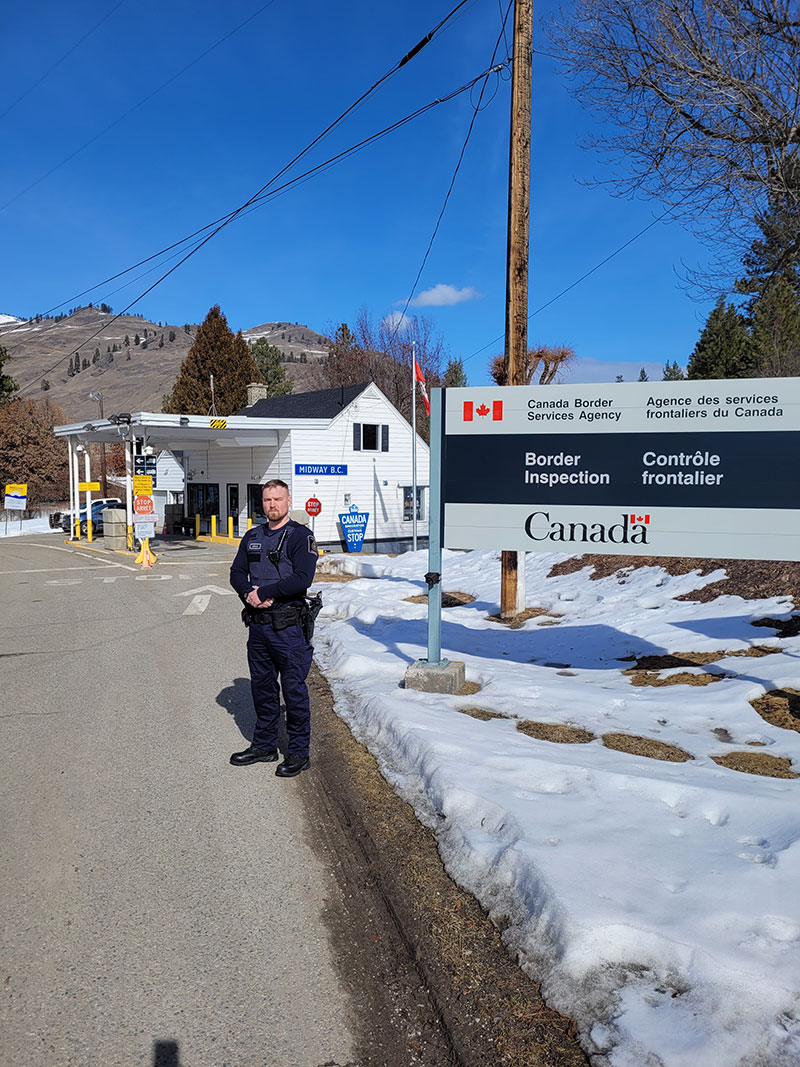
My placement turned into a career with several promotions at a customs brokerage. I am now a Border Services Officer (BSO) with the Canada Border Services Agency (CBSA). This program helped me build my toolkit of skills to be successful in law enforcement.
Steve Verkuyl - Custom/Border Services Administration